
How Much Protein in 100 g Mutton? Raw, Cooked and Curry Guide
Written By
DietOwl Nutrition Team
Published
4 November 2026
Reading Time
14 min read
100 grams of raw edible mutton gives about 20 grams of protein. India's IFCT 2017 nutrient tables list 18 to 22 grams depending on the cut and whether it is goat or sheep, and that is the safest range to use before you start adjusting for cooking, bones, fat, or gravy.
Mutton looks like a simple food label question, but the answer changes fast once the cut, the cooking method, and the portion style enter the picture. That's why Indian households often undercount or overcount protein when they log mutton by sight instead of by edible weight.
Table of Contents
- How Much Protein in 100 gm Mutton, The Direct Answer
- Complete Macronutrient Profile of Lean Mutton
- Raw Versus Cooked Weight: Why It Changes Protein Counts
- Understanding Edible Portion Versus Purchased Weight
- How Indian Cooking Methods Affect Protein Content
- Micronutrients Beyond Protein in Mutton
- Comparing Mutton Protein With Other Indian Meats
- Practical Portion Guidance for Daily Protein Targets
- Real Examples Of Protein Calculation Across Preparations
- Quick Reference Summary for Mutton Protein
How Much Protein in 100 gm Mutton, The Direct Answer
100 grams of raw edible mutton gives about 20 grams of protein. That baseline comes from India's IFCT 2017 food tables, which list 18 to 22 grams across goat and sheep cuts and are especially useful for Indian households because the samples were drawn across India's six geographical regions, not from imported data that may not match local meals.
That number applies to raw, boneless edible meat. It does not describe a bone-in shop cut, a fatty curry, or a cooked dish with gravy. Once trimming, moisture loss, and cooking style enter the picture, the protein you log can shift even when the plate still looks like "100 g mutton."
Practical rule: if you weighed the raw edible meat before cooking, about 20 grams per 100 grams is the first number to log. After that, adjust only for the real serving style, such as bones, fat, or gravy.
That is the clean starting point for macro tracking. A WhatsApp coaching log works best when the entry matches the actual weight you measured, because "100 g mutton" can mean very different things in an Indian kitchen.
Complete Macronutrient Profile of Lean Mutton
A 100 gram portion of raw mutton carries more than protein alone, so the macro picture matters. In IFCT 2017, raw goat meat provides about 136 to 188 kilocalories per 100 grams and sheep meat about 119 to 201 kilocalories, depending on the cut. Protein supplies roughly 36 to 60% of that energy when counted at 4 kilocalories per gram, and most of the rest comes from fat.
What that means in plain language
Protein is doing most of the nutritional work here, but fat is still part of the package. That is why the same serving can feel filling while also adding more calories than many people expect, especially if the cut is not trimmed well.
| IFCT 2017, raw meat per 100 g | Protein | Fat | Energy |
|---|---|---|---|
| Goat, chops | 20.4 g | 6.0 g | 136 kcal |
| Goat, legs | 22.1 g | 7.9 g | 160 kcal |
| Goat, shoulder | 20.3 g | 11.9 g | 188 kcal |
| Sheep, chops | 18.0 g | 5.2 g | 119 kcal |
| Sheep, leg | 21.4 g | 8.7 g | 164 kcal |
| Sheep, shoulder | 18.2 g | 14.3 g | 201 kcal |
For Indian households tracking meals for weight control or diabetes planning, this balance matters. A protein-rich food can support fullness, but the calorie total still needs attention. A neat-looking serving on the plate can still be easy to overserve if the cut is fatty or the portion is larger than expected.
Useful lens: a high protein number does not cancel out the calories around it. Check the full macro picture before you log the serving.
For WhatsApp coaching logs, this is the point to keep clear. Lean mutton gives a strong protein load for its size, but once bone, fat, and cooking liquid enter the meal, the final macro balance changes quickly.
Raw Versus Cooked Weight: Why It Changes Protein Counts
Raw and cooked mutton don't weigh the same, and that's where many people get tripped up. 100 grams of cooked meat is not nutritionally equivalent to 100 grams of raw meat, because cooking removes water and changes weight without creating new protein.
Why the number changes
If raw mutton gives around 20 grams of protein per 100 grams, the cooked version can appear to have a higher protein concentration per 100 grams because the meat has lost moisture. The protein didn't increase, the water content dropped, so the same protein is packed into a smaller weight.
A curry changes the picture again. Once gravy, oil, onion, tomato, and other ingredients are mixed in, the protein per 100 grams of the final dish can drop, because the weight now includes everything on the plate, not just meat. That's why a spoonful of curry and a weighed portion of lean meat should never be logged the same way.
| Weight type | What it represents | Protein logging risk |
|---|---|---|
| Raw edible meat | Lean meat before cooking | Best baseline |
| Cooked meat | Moisture-adjusted meat only | Higher protein density by weight |
| Curry or mixed dish | Meat plus gravy and other ingredients | Can dilute protein per 100 g |
For macro logging, the safest habit is to weigh the edible meat separately whenever you can. If you can't, treat the cooked dish as a mixed recipe, not as pure meat.
Understanding Edible Portion Versus Purchased Weight
A mutton pack bought at market weight is rarely the same as the amount you eat. Bones, connective tissue, and visible fat all reduce the edible part, so the number on the butcher's scale can mislead your macro log. IFCT 2017 figures such as about 22 grams of protein per 100 grams of raw goat leg describe the boneless edible meat itself, not a household serving with bone (Indian Food Composition Tables 2017, ICMR-NIN).
A more reliable way to log it
Start with the edible meat, not the full packet or the full restaurant plate. In IFCT 2017, raw goat shoulder and chops give about 20 grams of protein per 100 grams and goat legs about 22 grams, so the cut matters as well as the weight.
Practical rule: if the plate has bones or gravy, do not log the whole plate as protein-bearing meat.
A 250 g serving at home or in a restaurant is not automatically 250 g of protein-bearing meat. Some of that weight may be bone, fat, or gravy, so the useful number for logging is the edible portion only. That is why a kitchen scale helps, but only if you weigh what will be eaten.
For Indian families, the right question is simple: was it curry pieces, boneless meat, keema, or biryani? Each one carries a different edible weight, just as a tea cup and a soup bowl may hold very different amounts even if both are "one serving." That is the point DietOwl's WhatsApp coaching tries to make clear, because accurate tracking starts with the part you can eat, not the weight you bought.
How Indian Cooking Methods Affect Protein Content
Indian cooking doesn't just change flavour, it changes density. A pressure-cooked mutton dish, a slow-simmered curry, a dry keema, and a biryani all land differently on the plate because each method changes how much water, fat, rice, and gravy end up in the serving.
Common Indian preparations, different logging logic
- Curry pieces: The protein comes from the meat, but gravy dilutes the per-100-gram figure because the dish includes oil and vegetables.
- Biryani: Rice lowers the meat density per spoonful, so the protein per serving depends on how many meat pieces you got.
- Keema: Because the meat is minced and mixed, the edible meat is easier to estimate, but added fat still changes the calorie load.
- Tandoori chops: Moisture loss and fat dripping can change the final weight, so the cooked piece may look smaller than the raw cut.
- Pressure-cooked dishes: These often retain more moisture inside the final dish, so the cooked weight can feel different again.
The useful habit is to think in terms of edible meat per dish, not just the dish name. A bowl of curry can be mostly gravy with a few pieces, while a plate of keema may be much closer to a meat-centric serving. The same recipe style doesn't guarantee the same protein intake.
Micronutrients Beyond Protein in Mutton
Protein is only one reason people value mutton. It also brings micronutrients that matter for blood health, immunity, nerve function, antioxidant defence, and energy metabolism. That broader profile is one reason mutton often feels more satisfying nutritionally than a plain protein number suggests.
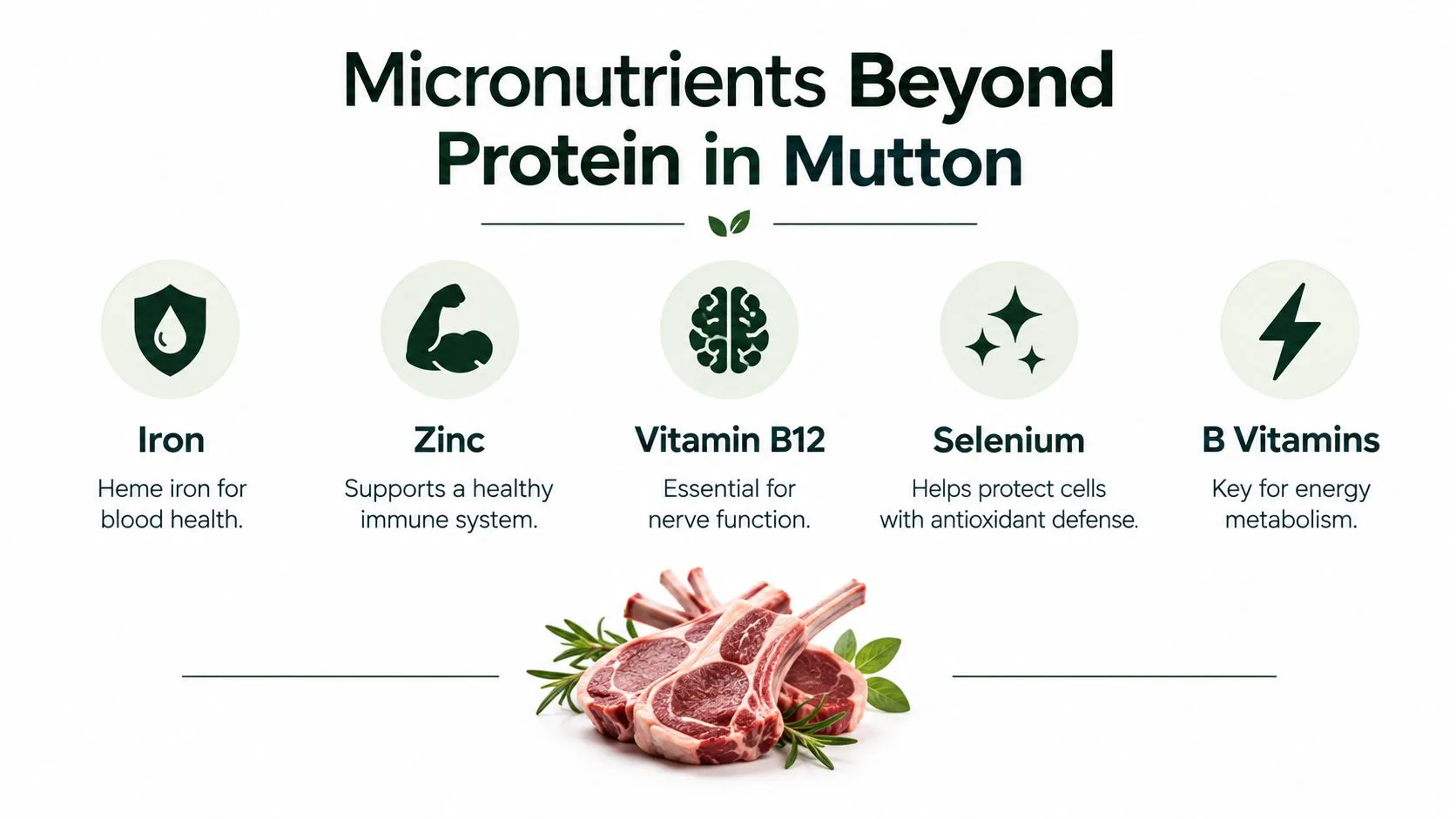
Iron supports blood health, zinc supports immune function, vitamin B12 supports nerve function, selenium contributes to antioxidant defence, and B vitamins help with energy metabolism. Those nutrients matter in Indian diets where fatigue, low intake quality, and mixed eating patterns often show up together.
For readers who also think about cholesterol and richer cuts, it helps to keep the whole meal in view. The calorie and fat side of the plate matters alongside the nutrient upside, especially if mutton is eaten often. This Indian-diet cholesterol guide is useful background for understanding how rich foods fit into a balanced pattern.
Mutton can therefore be a useful food for people who want more than basic protein. The trade-off is simple, lean cuts are easier to fit into a routine, while fattier cuts raise the calorie load quickly.
Comparing Mutton Protein With Other Indian Meats
Mutton sits in the same broad protein family as other animal foods, but each option behaves differently in daily eating. Protein per 100 grams is only one part of the decision, because fat level, cooking style, and portion habit all matter too.
| Protein Comparison: Common Indian Meat Sources Per 100g | Protein (g) | Key Characteristics |
|---|---|---|
| Mutton (goat or sheep), raw edible | 18 to 22 | Rich flavour, higher fat potential if untrimmed |
| Chicken breast, skinless, raw | 21.8 | Typically chosen for leaner eating |
| Fish (rohu, catla, pomfret, mackerel), raw | 18 to 21.5 | Often preferred for lighter meals |
| Egg, whole, raw | 13.3 | Easy to portion, versatile |
| Paneer | 18.9 | Different amino acid profile and higher fat depending on preparation |
The point of this comparison is not to crown one food as universally best. Mutton works well when you want a satisfying red-meat option and you're paying attention to portion size. Chicken or fish may suit leaner calorie goals better, while eggs and paneer fit different meal patterns and cultural preferences.
Decision rule: choose the protein that matches your portion control, digestion comfort, and cooking style, not just the one with the biggest label number.
For many Indian households, the most practical approach is rotation. Keep mutton in the mix when you want it, but don't let one protein source define the whole week. That gives you better control over calories, fats, and food monotony.
Practical Portion Guidance for Daily Protein Targets
A good starting point is simple, 100 grams of raw lean mutton is a solid protein serving, but it still needs to fit into the day's total intake. For weight loss, the goal is to keep protein high enough to support fullness while keeping calories in check. For muscle gain, the whole day matters, not just one plate.
In Indian meals, portion size often gets judged by eye, and that is where errors creep in. A katori of curry, a plate of biryani, and a home-style serving of meat pieces can look similar from a distance, even when the actual meat content is very different. For a clearer way to match portions with daily intake, see this protein requirement guide for Indians, which helps connect body weight, activity, and protein needs.
A simple logging habit
- Identify the form of the food, curry pieces, boneless meat, keema, or biryani.
- Separate edible meat from bones and gravy if you can.
- Log the edible meat accurately, not the raw purchase weight. If you weighed it after cooking, don't apply the raw per-100 g figure to that weight.
- Adjust for the recipe, because mixed dishes dilute meat density.
Raw versus cooked weight matters here. Raw mutton includes water that changes during cooking, while bones, gravy, and rice can make a serving look bigger than the actual meat inside. For WhatsApp-style coaching, this is the kind of detail that helps people log food accurately without making the process complicated.
For people with diabetes, hypertension, thyroid issues, or PCOS, this level of detail matters even more. The same protein source can fit very differently depending on what else is on the plate, how often it appears, and whether the meal was cooked with extra fat.
Real Examples Of Protein Calculation Across Preparations
A few real-world examples make the math clearer than any table can. They also show why guessing protein from the dish name alone leads to errors.
A home-cooked mutton curry made from raw lean meat can deliver a protein amount close to the raw baseline if most of the meat ends up in the bowl and the gravy is modest. A restaurant biryani can look heavier on the plate but deliver less meat per serving because rice, oil, and masala share the weight. Keema is easier to estimate when the mince is evenly mixed, but the final protein still depends on how much fat and added ingredients are in the dish.
Tandoori chops can look smaller after cooking because moisture and some fat are lost, so the cooked piece may seem deceptively light. Pressure-cooked mutton usually retains a softer texture and can hold more visible liquid, which changes the way the serving weighs out in the hand.
The main lesson is simple. The same raw starting weight can turn into very different edible servings, so the only dependable estimate is the one tied to the actual plate in front of you. Once you train your eye to separate meat from bone, gravy, and rice, your protein logging becomes much more accurate.
Quick Reference Summary for Mutton Protein
Use about 20 grams of protein per 100 grams of raw edible mutton as the baseline for Indian food logs. That figure aligns with IFCT 2017 (18 to 22 grams depending on the cut and animal) and gives you a practical starting point for WhatsApp coaching or any food diary.
Raw and cooked weights are different because cooking removes water, so the same meat can weigh less after it is cooked even though the protein itself has not vanished. Bone-in servings are different too, because the bone is part of the purchase weight but not part of the edible protein on the plate.
A quick check keeps the math clean. Is it raw or cooked? Is it boneless or bone-in? Is it plain meat or part of a mixed recipe? Those three questions prevent most logging errors before they start.
For portion sizing, the portion control guide for Indian katoris gives a useful frame for everyday Indian meals.
Related Topics
Biological Audit
Need a customized Indian Food Science plan?
Join 100+ Indians on a personalised Indian plan, on WhatsApp.
Deepen your Discovery.

Tofu vs Soya Chunks vs Paneer: Which Protein Is Best for Indians?
Dry soya chunks win on protein per 100 g, but that is dry weight. Here is how tofu, soya chunks and paneer really compare, with Indian data and goal-wise picks.

Eating Amla Daily: Benefits, Best Forms and Who Should Be Careful
What eating amla daily can and cannot do: nutrition per 100 g, what the studies show, which form to choose, and who should check with a doctor first.

High-Protein Vegetarian Indian Foods: 20 Everyday Options
A practical list of 20 high protein vegetarian Indian foods with rough protein per serving, plus simple combinations that make your dal-roti-sabzi plate work harder for you.