
Thyroid Diet Food: A Practical Indian Guide
Written By
DietOwl Nutrition Team
Published
28 October 2026
Reading Time
13 min read
You open the lab message, see "high TSH", and suddenly every meal in your kitchen feels suspicious. Someone at home says to stop curd, another says to cut cabbage, and a relative forwards a chart about seaweed, rock salt, and miracle foods. If that sounds familiar, you're not alone, and you don't need a foreign food list to make sense of your plate.
A useful thyroid diet food plan in India starts with the kitchen you already have, not a perfect one. For most newly diagnosed adults, the questions are simple, what salt is in the tin, when do you take your tablet, and which foods are helping you meet your needs without making life harder. The calm answer is usually more practical than the internet noise.
Table of Contents
- A New Diagnosis in an Indian Kitchen
- How the Thyroid Works and Why Food Matters
- Iodine and the Indian Salt Reality
- The Goitrogen Myth in Indian Cooking
- Beyond Iodine The Other Thyroid Nutrients
- A Day of Thyroid Diet Food on an Indian Plate
- Levothyroxine, Calcium, Iron and the Meal-To-Dose Rule
- Your Personalised Thyroid Diet Food Checklist
A New Diagnosis in an Indian Kitchen
The first reaction is often panic, then the fridge gets reorganised. One person cuts out rice, another removes milk, and a third tells you that all cruciferous vegetables are dangerous. In a typical Indian home, that advice collides with dal, roti, sabzi, idli, curd, and the family meal schedule within a day.
A better starting point is to separate medical treatment, iodine adequacy, and everyday meal choices. In India, hypothyroidism is common enough that food advice should feel local and realistic, not imported and extreme. The goal is not to build a "perfect thyroid plate", it's to support your treatment, keep meals workable, and avoid unnecessary restriction.
What a practical plan looks like
A newly diagnosed patient usually needs three things at once, medication guidance, a salt check, and a food pattern that doesn't fight the prescription. That means asking whether the household uses reliably iodised salt, whether the tablet is taken consistently, and whether the day's meals are built around familiar foods. It does not mean banning whole food groups based on social media posts.
Practical rule: if a food list makes your normal Indian meals feel impossible, it's probably too generic to be useful.
For many people, the useful shift is small. Keep your roti, rice, dal, vegetables, curd, eggs, and fish where they fit, then adjust the parts that matter for thyroid management. Your diagnosis and prescription still come first.
How the Thyroid Works and Why Food Matters
The thyroid sits at the front of the neck and makes hormones that help regulate metabolism, body temperature, digestion, and energy. Those hormones, especially T3 and T4, depend on iodine as a key building block. When hormone production falls, hypothyroidism can show up as fatigue, weight changes, constipation, dry skin, or feeling slowed down.
That matters in India because thyroid disease is not rare or abstract. In a multicity study of 5,376 adults across eight Indian cities, the estimated overall hypothyroidism prevalence was 10.95%, with 587 participants affected and variation from 8.88% in Hyderabad to 21.67% in Kolkata PMC study on hypothyroidism in Indian cities. This is exactly why "thyroid diet food" should be personalised, not copied from an overseas blog.
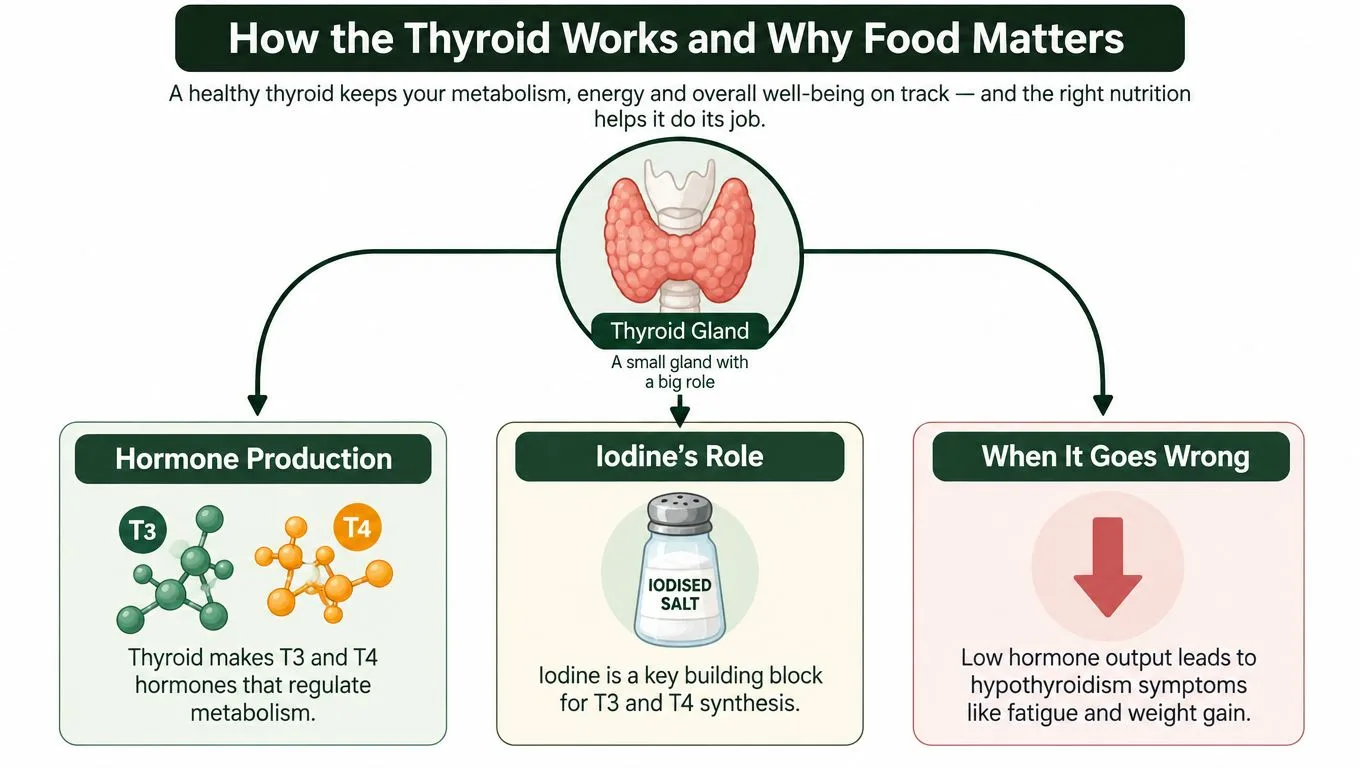
Food supports the system, it doesn't replace treatment
A food plan can help you get enough iodine, protein, and other nutrients, and it can make weight management easier when appetite or fatigue shift. It cannot diagnose thyroid disease, and it cannot replace levothyroxine or other prescribed therapy. If your medication needs adjusting, only TSH and free-T4 monitoring can tell that story properly.
The point is simple. Food helps the body have what it needs, but medication treats the hormonal gap when the thyroid can't keep up. That's why a good Indian plan looks at the whole picture, diagnosis, symptoms, household cooking, and the timing of treatment.
Iodine and the Indian Salt Reality
Iodine gets more attention than almost any other thyroid nutrient, and for good reason. The thyroid needs it to make hormone, and Indian public-health guidance places adult needs at around 150 micrograms/day, with 250 micrograms/day during pregnancy and lactation ICMR-NIN dietary guidance. That's a normal daily need, not a reason to start taking high-dose tablets.
The core household issue is salt. In the first National Iodine and Salt Intake Survey, 91.7% of Indian households used salt with at least 5 ppm iodine, while 77.5% consumed adequately iodised salt at 15 ppm or more National Iodine and Salt Intake Survey. The survey also showed that packaging mattered, because adequately iodised salt was more common in packaged salt than in non-packaged salt.
What to do at home
Buy reliably iodised packaged salt, use it in measured amounts, and don't replace it completely with non-iodised rock salt. Crystal salt and loosely sold salt are more likely to fall short, so they shouldn't be your main iodine source. If the label or source of the salt is unclear, treat that as a reason to check, not assume.
A later eight-centre Indian study found that more than 90% of households reported iodised-salt use and 89% of tested salt samples contained more than 15 ppm iodine same nationwide study. That's reassuring, but it still doesn't mean more iodine is better.
Practical rule: standard iodised salt in normal cooking is useful, iodine drops or kelp are not a default.
If you've been tempted by "thyroid support" supplements or kelp tablets, be cautious. In real kitchens, the safer move is usually boring, consistent iodised salt plus clinician-guided treatment.
The Goitrogen Myth in Indian Cooking
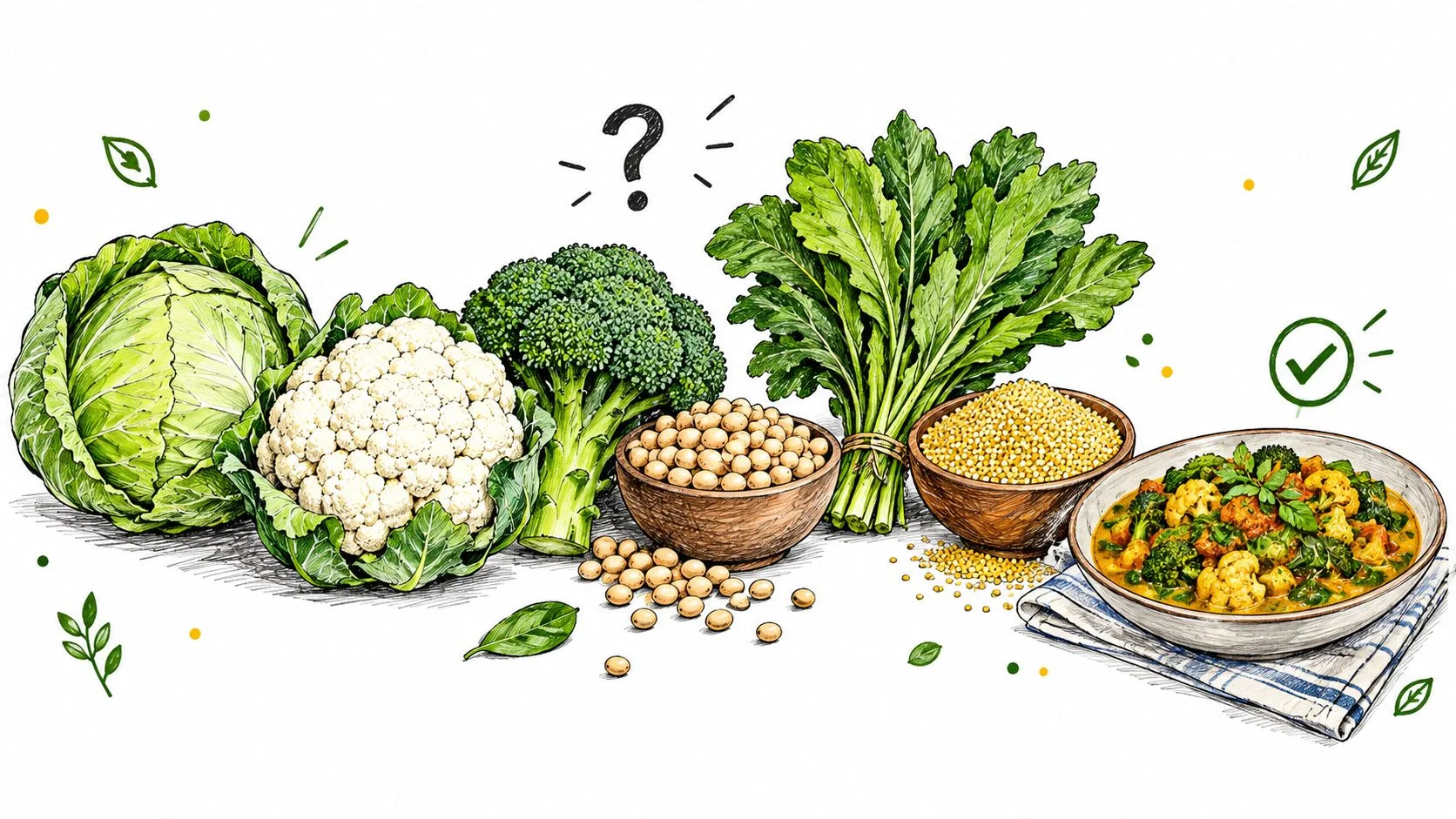
The internet loves a forbidden-food list, especially for cabbage, cauliflower, soy, and millets. That's where many people waste energy, because the risk is usually about context, not the food name itself. Normal cooked servings in a mixed Indian diet are not the same as repetitive raw intake in a person with iodine deficiency.
India's own nutrition guidance is more useful than blanket fear. It notes that cruciferous and other traditionally labelled goitrogenic foods, including cabbage, cauliflower, mustard, soybean, and sorghum, don't need automatic elimination, and cooking and variety matter more than harsh avoidance ICMR-NIN guidance. The food pattern around them matters too, especially whether iodised salt is used at home.
When the concern is real
Very high, repetitive intake of raw crucifers or soy is the situation that deserves attention, not the occasional sabzi. If someone is already diagnosed with thyroid disease, has known iodine deficiency, or is eating unusually large amounts of raw sprouts, smoothies, or soy products, then the discussion becomes more specific. For everyone else, removing affordable vegetables and millets often causes more harm than benefit.
A small household filter helps here. Ask whether the food is cooked, how often it appears, and what else is on the plate. That simple lens is usually more accurate than labelling foods "bad".
For a deeper local breakdown of this debate, the internal guide at https://dietowl.in/blog/goitrogens-thyroid-indian/ is worth reading alongside your own meal routine.
Beyond Iodine The Other Thyroid Nutrients
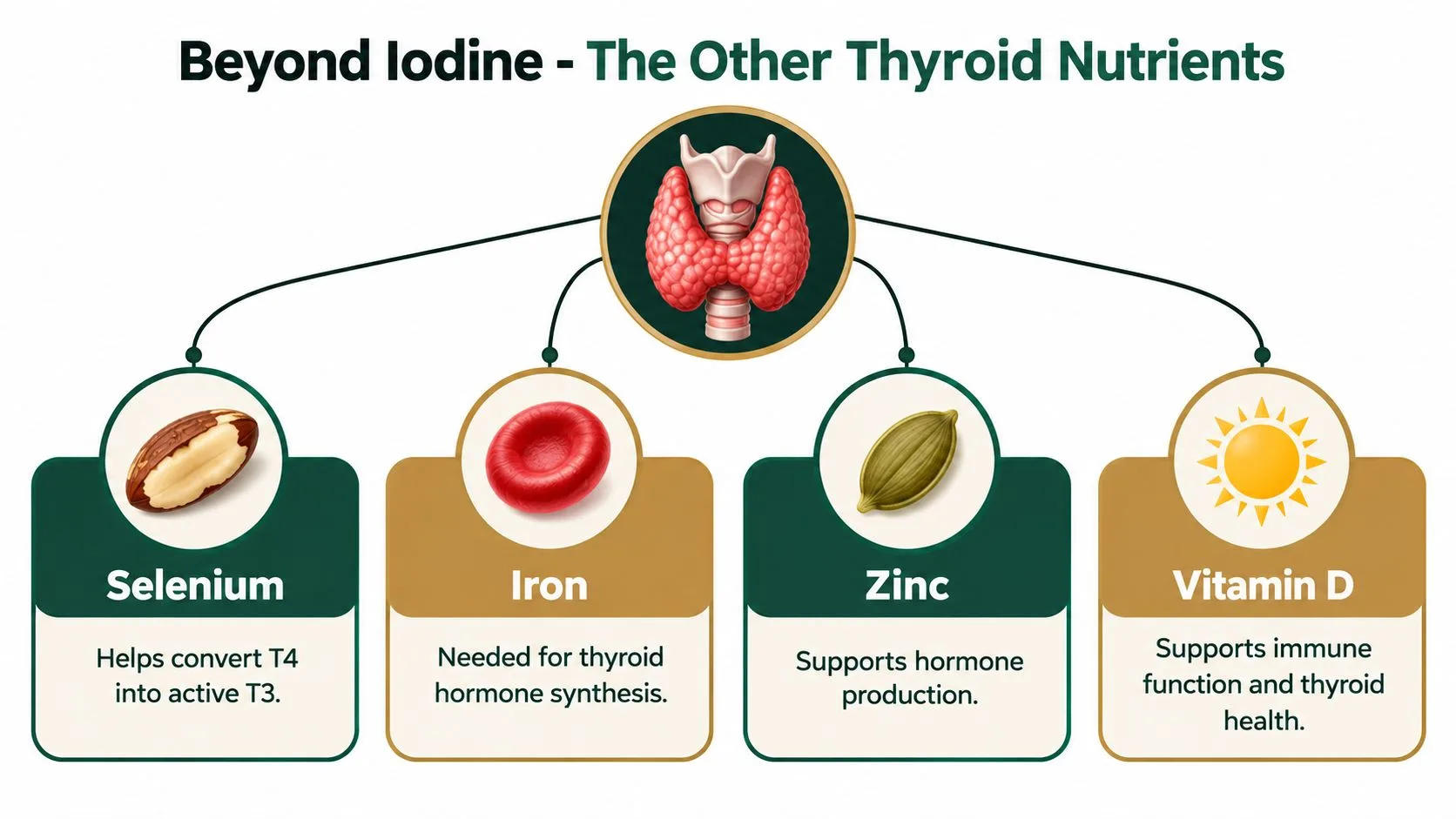
Iodine gets the most attention, but it isn't the only nutrient that matters for thyroid-supportive eating. Selenium, iron, zinc, vitamin D, and enough protein all play supporting roles in hormone production, conversion, immune balance, and satiety. That's why a good thyroid diet food pattern looks like a normal Indian shopping list, not a luxury diet.
What to put on the plate
Selenium is found in foods like eggs, fish, and Brazil nuts, and it helps the body convert T4 into active T3. Iron matters because low iron status can make thyroid work harder, so rajma, chana, leafy vegetables, meat, and fish can all help when they fit the person's diet. Zinc supports hormone production and shows up in dals, paneer, curd, seeds, eggs, and seafood.
Vitamin D is a different kind of support, more about immune function than direct hormone building. Fortified milk, eggs, and clinician-directed testing matter more than guessing. Protein then ties the whole plate together, because people with low energy often eat too little at meals and end up hungry later.
If your thyroid diet plan feels stripped down to "avoid this" and "avoid that", it's missing the nutrients that actually keep meals satisfying.
A practical Indian plate can include dal, curd, eggs, paneer, fish, chana, rajma, pumpkin seeds, and vegetables you already know how to cook. The point isn't to chase imported superfoods. It's to build a steady pattern from familiar foods and test before supplementing where needed.
For readers who want another nutrient-focused view, the internal guide at https://dietowl.in/blog/thyroid-nutrients-iodine-selenium/ fits well with this approach, especially if you're trying to decide which foods deserve a blood test before you buy pills.
A Day of Thyroid Diet Food on an Indian Plate
A workable day starts with breakfast that doesn't fight your routine. In a South Indian home, that might mean idli or dosa with sambar, a little curd on the side, and a boiled egg if the person eats eggs. In a North Indian home, it might be roti, dal, sabzi, and dahi, with fruit added when convenient.
Lunch can stay familiar. Rice with dal and vegetables works well, and if fish or paneer fits your household, those can sit beside the usual sabzi without making the meal feel "special". A small portion of millet, brown rice, or both can be included if the person likes them and tolerates them well.
Make snacks and drinks work for the tablet
The evening is where many people get tripped up, because chai, calcium tablets, and dinner often collide. If you take levothyroxine in the morning, keep your breakfast and chai timing consistent. If your routine is bedtime dosing, the earlier meal needs to be far enough away, and that gap has to be reliable.
A useful snack pattern is simple. Buttermilk or nimbu paani can fit between meals, and a handful of nuts or roasted chana can work better than random packaged snacks. If chai with milk is a must, treat it as part of the meal pattern, not as a neutral drink.
South Indian and North Indian plates can both support thyroid nutrition if the structure is steady. The food doesn't need to be exotic, just predictable enough that your medication schedule and appetite aren't always fighting each other.
Levothyroxine, Calcium, Iron and the Meal-To-Dose Rule
For many people on levothyroxine, the biggest issue isn't a "bad" food, it's a badly timed dose. In an Indian study during Ramadan, bedtime dosing needed at least a 2-hour interval after dinner, and the meal-to-dose interval correlated significantly with TSH variation Indian Journal of Endocrinology and Metabolism. A South Indian randomised study of 123 post-thyroidectomy patients found no significant TSH difference between morning dosing taken 1 hour before food and bedtime dosing taken 2 hours after food, which supports either routine when it's done consistently same source.
The point is simple. Take the tablet with water, keep it separate from breakfast, and avoid switching the timing day by day. If bedtime dosing is easier, make the evening meal-to-dose gap dependable, not approximate.
| Food or supplement | Effect on thyroid diet food plan | Recommended gap with levothyroxine |
|---|---|---|
| Breakfast tea with milk | Can interfere if taken too close to the tablet | Keep the tablet first, then breakfast later |
| Calcium supplement | May reduce absorption | Separate and confirm timing with a clinician |
| Iron supplement | May reduce absorption | Separate and confirm timing with a clinician |
| High-fibre supplement | Can affect absorption in some people | Keep a consistent gap |
| Antacid | May interfere with the dose | Ask a clinician or pharmacist about spacing |
| Bedtime meal | Matters most if dosing at night | Keep a reliable 2-hour interval |
If iron deficiency is part of the picture, the guide at https://dietowl.in/blog/iron-anaemia-indian-women/ is a sensible companion read, because low iron and thyroid symptoms can look annoyingly similar.
Your Personalised Thyroid Diet Food Checklist
Start with the salt tin at home. Check whether it's iodised, keep the salt use moderate, and don't replace it with fashionable non-iodised options unless your clinician has a reason. Then write down three Indian foods you'll eat this week that give you protein or key nutrients, such as eggs, dal, curd, fish, chana, rajma, paneer, or seeds.
Fix your medication routine next. Decide whether levothyroxine will be a morning or bedtime habit, keep the gap consistent, and stop guessing based on how tired you feel on one day. Book the next TSH test if your clinician has asked for follow-up, and don't self-prescribe iodine drops or kelp.
- Check the salt label: make sure the household uses iodised salt regularly.
- Keep a stable tablet routine: same timing, same gap, same water.
- Build from Indian staples: dal, roti, rice, sabzi, dahi, eggs, fish, paneer, and legumes.
- Avoid unnecessary bans: don't cut cabbage, cauliflower, soy, or millets without a clear reason.
- Ask before supplementing: especially for iodine, iron, calcium, and vitamin D.
If you're pregnant, planning pregnancy, or noticing symptoms changing despite treatment, involve your clinician promptly. Personalised meal review also helps when your actual kitchen, work schedule, and tablet timing keep colliding, because thyroid care works best when it fits the way you really eat.
DietOwl helps turn that kind of advice into a day-to-day plan using your actual Indian meals, medication schedule, and household routine. If you want a thyroid-focused nutrition plan that fits rice, roti, dal, chai, and your treatment timing, visit DietOwl and see how personalised coaching can make the next week easier to follow.
Related Topics
Biological Audit
Need a customized Thyroid & Hormonal Health plan?
Join 100+ Indians on a personalised Indian plan, on WhatsApp.
Deepen your Discovery.

Is Cabbage Bad for Thyroid? The Truth About Goitrogens
Goitrogens in cabbage, cauliflower and broccoli sound scary, but cooking deactivates most of them and normal Indian portions are fine. An evidence-based, reassuring look at goitrogens and thyroid health.

Can You Lose Weight with Hypothyroidism? An Indian Guide
Yes, weight loss with thyroid trouble is possible, but it works differently. Here is why it feels harder, why medication levels come first, and how protein, strength training and patience fit, all with everyday Indian food.

Foods to Avoid with Hypothyroidism: The Indian List
A calm, honest Indian list of foods to avoid with hypothyroidism. Nuance, not fear: soy timing around your tablet, raw goitrogens in excess, too much iodine and ultra-processed food. Most everyday foods stay on your plate.