
Calories in 1 Roti, and How Much Rice Equals One Roti
Written By
DietOwl Nutrition Team
Published
24 November 2026
Reading Time
12 min read
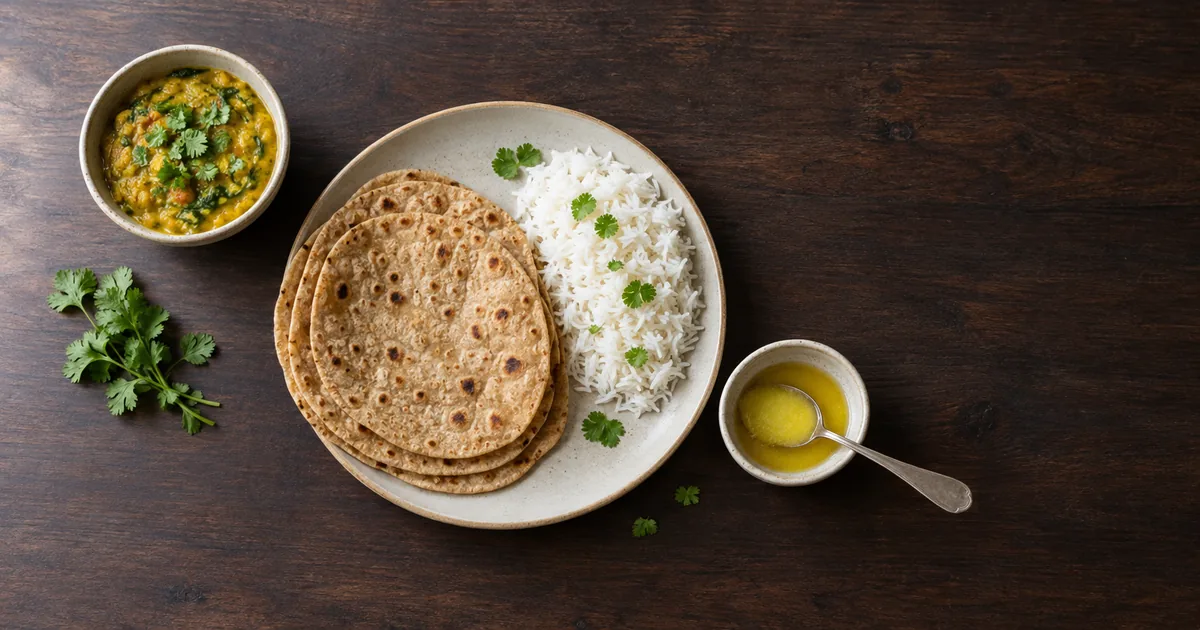
One plain roti made from 30 g of whole wheat atta has about 96 calories and 19 g of carbohydrate (IFCT 2017). By calories that matches about 74 g of cooked white rice, and by carbs about 68 g, so one roti equals roughly 70 to 75 g of cooked rice, a little under half of USDA's 158 g cup (USDA FoodData Central). Home rotis vary a lot, so every sum is shown below and you can redo it for your own.
Roti, chapati and phulka all count the same here: whole wheat flour and water, cooked on a tawa or over the flame. The calories come from the atta. The water in the dough adds weight and no calories.
The sum for one roti
India's official food table, IFCT 2017, says all of its data except poultry and egg is for raw food, so the atta row describes dry flour (IFCT 2017). We assume 30 g of dry atta per roti and multiply each per-100 g value by 0.30.
| Nutrient | Atta per 100 g | Sum | One roti (30 g atta) |
|---|---|---|---|
| Calories | 320 kcal | 320 x 0.30 | 96 kcal |
| Carbohydrate | 64.17 g | 64.17 x 0.30 | 19.3 g |
| Protein | 10.57 g | 10.57 x 0.30 | 3.2 g |
| Fibre | 11.36 g | 11.36 x 0.30 | 3.4 g |
| Fat | 1.53 g | 1.53 x 0.30 | 0.5 g |
Source: Wheat flour, atta (A019), IFCT 2017. IFCT gives energy as 1340 kJ, which is about 320 kcal at 4.18 kJ per kcal.
This is an estimate. In an Indian lab comparison that used an older national food table, estimates adjusted for moisture differed from measured macronutrients by about 3 to 5 percent on average for cooked foods. Across a whole day's intake the gap grew, to about 8 percent for energy and 27 percent for fat (Chiplonkar and Agte, 2007). For your roti, the bigger unknown is its size.
Why 30 g of atta, and how to check yours
The 30 g is our working assumption for a medium home roti. We did not find a trusted source for what the average Indian home roti weighs, so here is how to check your own. A lab recipe from CFTRI Mysore mixed 500 g of whole wheat flour with 325 ml of water (CFTRI chapati study). Counting that water as 325 g, the dough weighs 825 g, and 500 / 825 = 0.606, so the dough is about 61 percent flour by weight. A 50 g dough ball therefore holds about 30 g of atta (50 x 0.606), and the roughly 40 g of dough that lab rolled per chapati holds at most about 24 g (40 x 0.606), because it then cut the sheet into a circle (CFTRI chapati study). Home dough varies, so treat this as a guide.
| Atta in one roti | Dough ball (atta / 0.606) | Calories | Carbs |
|---|---|---|---|
| 25 g | 41 g | 80 kcal | 16.0 g |
| 30 g | 50 g | 96 kcal | 19.3 g |
| 40 g | 66 g | 128 kcal | 25.7 g |
| 50 g | 83 g | 160 kcal | 32.1 g |
Source: atta values from IFCT 2017, dough ratio from the CFTRI chapati study.
This is also why roti numbers disagree. A figure of 70 to 80 calories fits about 22 to 25 g of atta, and 100 to 120 calories fits about 31 to 38 g (IFCT 2017). Each is right for some roti. The easy way to find yours is to weigh the atta for one batch, count the rotis it makes, and divide.
Calories in 1, 2, 3 and 4 rotis
| Rotis | Plain | With 1/2 tsp ghee each | With 1 tsp ghee each | Carbs | Protein | Fibre |
|---|---|---|---|---|---|---|
| 1 | 96 kcal | 119 kcal | 141 kcal | 19.3 g | 3.2 g | 3.4 g |
| 2 | 192 kcal | 237 kcal | 282 kcal | 38.5 g | 6.3 g | 6.8 g |
| 3 | 288 kcal | 356 kcal | 423 kcal | 57.8 g | 9.5 g | 10.2 g |
| 4 | 384 kcal | 474 kcal | 564 kcal | 77.0 g | 12.7 g | 13.6 g |
Source: roti values from IFCT 2017 at 30 g of atta per roti. Ghee is counted at 5 g per teaspoon and 9 kcal per gram of fat (DGI 2024).
What ghee adds
Ghee is almost entirely fat, so a 5 g teaspoon adds 5 x 9 = 45 kcal, which takes one roti from 96 to 141 kcal (DGI 2024). The same guidelines say to limit ghee or butter to 1 to 2 teaspoons a day, so three rotis with a teaspoon on each goes past that (DGI 2024). Our ghee guide covers how to use it. For a paratha, count each teaspoon of oil or ghee at 45 kcal (DGI 2024).
Is roti protein or carbohydrate?
Roti is a carbohydrate food. At 4 kcal per gram (DGI 2024), the 19.3 g of carbohydrate supplies about 77 of the 96 kcal, which is 80 percent, while the 3.2 g of protein supplies about 13 percent (IFCT 2017). So count roti as your grain, and get your protein from dal, curd, paneer, eggs, fish or chicken. Our list of high-protein vegetarian foods helps here.
If you searched "chapati is rich in", the honest answer is carbohydrate first, then fibre. One roti gives 3.4 g of fibre and about 1.2 mg of iron (4.10 x 0.30) (IFCT 2017). IFCT's carbohydrate figure counts only what the body digests and absorbs, and fibre sits in its own column, so adding the two gives about 22.7 g of total carbohydrate per roti (IFCT 2017).
1 roti is equal to how much rice?
IFCT has no cooked rice row, so we took the cooked figure from USDA's entry for cooked long-grain white rice: 130 kcal and 28.2 g of carbohydrate per 100 g, with 158 g in 1 cup (USDA FoodData Central). This is American data. We used it because we did not find a trusted Indian figure for plain cooked rice. By calories one roti is then 96 / 130 x 100 = 74 g of cooked white rice, and by carbs it is 19.3 / 28.2 x 100 = 68 g (USDA FoodData Central).
| Rotis (30 g atta each) | Cooked rice, same calories | Cooked rice, same carbs | In USDA cups (158 g each) |
|---|---|---|---|
| 1 | 74 g | 68 g | under 1/2 cup |
| 2 | 148 g | 137 g | just under 1 cup |
| 3 | 222 g | 205 g | about 1 1/3 cups |
| 4 | 295 g | 273 g | about 1 3/4 cups |
| 5 | 369 g | 341 g | about 2 1/4 cups |
Source: roti from IFCT 2017, cooked rice and the 158 g cup from USDA FoodData Central. USDA's carbohydrate figure includes 0.4 g of fibre and IFCT's does not, so the carb match is close rather than exact. USDA's cup is a US kitchen cup, bigger than the 200 ml cup and katori in India's guidelines (DGI 2024), so go by the grams and weigh your own serving once.
The two rice columns differ because rice gets more of its calories from starch, while a roti gets more from protein and fat.
If you measure rice before cooking, use raw weight, because it does not depend on how much water your rice took up. IFCT lists raw milled rice at 356 kcal and 78.24 g of carbohydrate per 100 g, so one roti matches 96 / 356 x 100 = 27 g of raw rice by calories, or 19.3 / 78.24 x 100 = 25 g by carbs (IFCT 2017).
How raw rice turns into cooked rice
Putting the two sources together, 356 kcal raw / 130 kcal cooked = 2.7, so 100 g of raw rice becomes about 274 g of cooked rice at USDA's water level (IFCT 2017, USDA FoodData Central). Real pots differ, and we did not find a trusted figure for rice cooked the Indian home way. Softer, wetter rice holds more water, so it has fewer calories per 100 g. To find your own number, weigh the raw rice, weigh all of it once cooked, and divide. Say your rice comes to 3 times its raw weight and you drained no water: 100 g of it then holds about 119 kcal (356 / 3), and one roti matches about 81 g (IFCT 2017).
2 rotis vs 1 bowl of rice, and 5 rotis at a meal
One cup of cooked rice (158 g) has about 205 kcal and 44.6 g of carbohydrate (USDA FoodData Central). Two rotis have 192 kcal and 38.5 g (IFCT 2017). So two 30 g rotis come to a little less than that 158 g cup of rice. For which one suits you, read our roti vs rice guide.
The catch is the word bowl. The menus in the national guidelines use a 200 ml katori, their measuring set runs from 115 ml to 360 ml, and a bowl at home can be anything (DGI 2024). Weigh your usual serving of cooked rice once, then compare it with the table above.
Five rotis come to 480 kcal and 96.3 g of carbohydrate before any ghee, about the same as 340 to 370 g of cooked rice (IFCT 2017, USDA FoodData Central). For scale, the national plate for a 2,000 kcal day has 250 g of cereals and millets by raw weight for the whole day, and five rotis use 150 g of that, or 60 percent, in one sitting (DGI 2024). It can suit someone doing hard physical work, but it is a lot for a desk day.
Jowar, bajra, ragi and rice rotis
IFCT lists jowar, bajra and ragi only as grains, with no flour rows, so we assume the flour is the whole grain, milled. It has no rice flour row, so we used raw milled rice, because rice flour is ground rice.
| Roti (30 g dry flour) | Calories | Carbs | Protein | Fibre | Fat |
|---|---|---|---|---|---|
| Wheat atta | 96 kcal | 19.3 g | 3.2 g | 3.4 g | 0.5 g |
| Jowar | 100 kcal | 20.3 g | 3.0 g | 3.1 g | 0.5 g |
| Bajra | 104 kcal | 18.5 g | 3.3 g | 3.4 g | 1.6 g |
| Ragi | 96 kcal | 20.0 g | 2.1 g | 3.4 g | 0.6 g |
| Rice flour | 107 kcal | 23.5 g | 2.4 g | 0.8 g | 0.2 g |
Source: IFCT 2017, per-100 g values x 0.30.
Jowar, bajra and ragi rotis land within about 8 kcal of a wheat roti of the same flour weight, so changing the grain does not cut calories by itself (IFCT 2017). Bhakri often runs thicker, which means more flour, so count the flour rather than the piece. Our jowar guide explains the grain in detail.
A rice roti has about 107 kcal, which matches about 82 g of cooked rice (107 / 130 x 100) (IFCT 2017, USDA FoodData Central). Is rice flour roti healthy? Akki roti, tandlachi bhakri and pathiri are good traditional food, and rice has no gluten. Its weak spot is fibre, at 0.8 g against 3.4 g for atta, so eat it with dal and a vegetable rather than on its own (IFCT 2017). If you have diabetes, our guide to atta for diabetics is the better read, and your doctor can help you set your carbohydrate portions.
Common mistakes when counting rotis
- Weighing the cooked roti and multiplying by 320. That figure is for dry atta, and a cooked roti still holds water, so count the atta or the dough ball (IFCT 2017).
- Using raw rice numbers for cooked rice. Raw milled rice is 356 kcal per 100 g and cooked rice is about 130 kcal (IFCT 2017, USDA FoodData Central).
- Leaving out the fat. One teaspoon of ghee on each of 4 rotis adds 180 kcal (4 x 45) (DGI 2024).
Key takeaways
- One roti from 30 g of atta has about 96 kcal, 19.3 g of carbs, 3.2 g of protein and 3.4 g of fibre (IFCT 2017).
- Size changes everything: 25 g of atta gives 80 kcal and 50 g gives 160 kcal (IFCT 2017).
- Each teaspoon of ghee adds about 45 kcal (DGI 2024).
- One roti matches about 70 to 75 g of cooked white rice, or about 25 to 27 g of raw rice, and two rotis come to a little under USDA's 158 g cup of cooked rice (IFCT 2017, USDA FoodData Central).
If you would like your own rotis, rice and ghee worked into a plan that suits your kitchen, our nutritionists do that with you on WhatsApp. You can read more about weight loss coaching at DietOwl.
Related Topics
Biological Audit
Need a customized Indian Food Science plan?
Join 100+ Indians on a personalised Indian plan, on WhatsApp.
Deepen your Discovery.

Tofu vs Soya Chunks vs Paneer: Which Protein Is Best for Indians?
Dry soya chunks win on protein per 100 g, but that is dry weight. Here is how tofu, soya chunks and paneer really compare, with Indian data and goal-wise picks.
Ramphal Fruit Disadvantages: What Indians Need to Know
Ramphal fruit disadvantages for Indian homes: toxic seed kernels, the sugar load for diabetes, sensible portions and how to prepare the pulp safely.
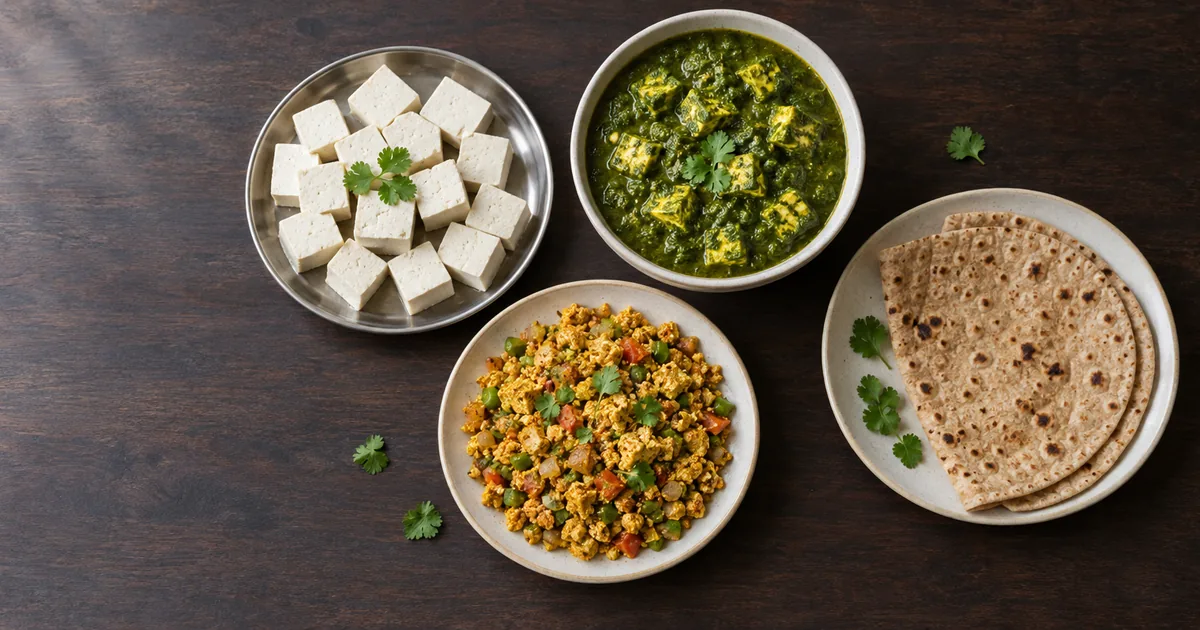
Soya Paneer Protein per 100g: Tofu Nutrition vs Milk Paneer
Soya paneer is simply tofu, and its protein depends on how firm the block is. Here are the real figures per 100 g, per 50 g and per serving, and how it compares with milk paneer.