
Soya Chunks Benefits: Protein, Side Effects and Daily Intake
Written By
DietOwl Nutrition Team
Published
27 November 2026
Reading Time
13 min read
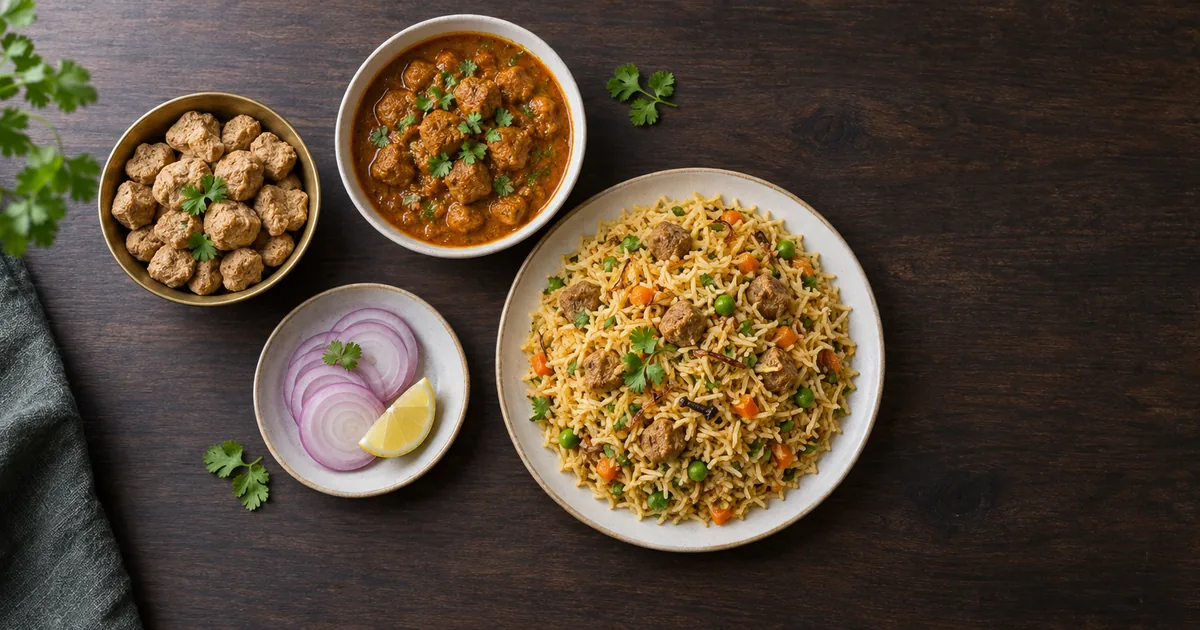
The main benefit of soya chunks is simple: a lot of protein with very little fat, at 50.0 to 55.8 g protein per 100 g dry (Foods 2022). The catch is the word dry. Chunks soak up water and end up nearly four times heavier, so 100 g of soaked chunks has roughly 13.5 g protein, by our estimate below (Foods 2022). For most people they are a safe, useful food, and that includes men.
This page covers soya chunks on their own. To see how they stack up against other proteins, read our tofu, soya chunks and paneer comparison.
What soya chunks are made of
Soya chunks are textured soy protein. FSSAI's standard calls it "Soy Bari or Soy Chunks or Soy Granules" and says it is "obtained by extrusion of defatted soy flour or grits" (FSSAI standards). In plain words, they are soybeans with the oil taken out, reshaped.
Here is how soya chunks are made. Most soy protein starts with soybeans that are dehulled and flaked, with the oil removed using a solvent called hexane, leaving flour or grits with about 50 to 54% protein (Lusas 1995). That goes through an extruder, where pressure, heat and mechanical force create the spongy, meaty structure (Foods 2022). FSSAI requires at least 50% protein on a dry matter basis, and limits moisture to 7%, fat to 1% of dry mass and leftover hexane to 10 ppm (FSSAI standards).
The trap: dry weight vs cooked weight
The headline protein figure is for dry chunks. Researchers soaked 14 commercial textured soy products in room-temperature water for 2 hours and drained them. They took up 1.5 to 3.8 g of water per gram, 2.8 g on average (Foods 2022). So 100 g of dry chunks typically became about 380 g, and anywhere from 250 to 480 g depending on the product (Foods 2022).
The protein stays the same, spread through more water. Dividing the study's average protein by its average swollen weight gives about 13.5 g protein per 100 g of soaked chunks, and sample by sample it ran from 10.4 to 20.6 g (Foods 2022). Those are our own sums, not a published figure. We found no official table for cooked soya chunks, these were American crumbles that were soaked rather than boiled, and squeezing out water pushes the number up. Treat it as an estimate.
| Dry chunks | Soaked weight, typical (range) | Protein | Energy |
|---|---|---|---|
| 25 g | 95 g (63 to 120 g) | 12.5 to 14.0 g | 82 to 92 kcal |
| 30 g | 114 g (75 to 144 g) | 15.0 to 16.7 g | 98 to 110 kcal |
| 50 g | 190 g (125 to 240 g) | 25.0 to 27.9 g | 164 to 183 kcal |
| 100 g | 380 g (250 to 480 g) | 50.0 to 55.8 g | 327 to 366 kcal |
Sources: our arithmetic from Foods 2022 for weight and protein. Energy uses USDA rows for defatted soy flour, one and two, explained below.
No kitchen scale? The dry soy products in that study, described as crumbles, weighed 238 to 384 g per litre (Foods 2022), so half of a 200 ml cup is roughly 24 to 38 g. Bigger pieces pack more loosely: USDA lists a cup of coarse dry textured protein at 68 g against 120 g for fine (USDA), so expect the lower end with large chunks. Our vegetarian protein list calls 30 g about a fistful before soaking.
Soya chunks nutrition per 100 g
| Per 100 g dry | Amount | Based on |
|---|---|---|
| Protein | 50.0 to 55.8 g | Lab test of 14 textured soy products |
| Total carbohydrate | 27.4 to 35.4 g | Same lab test |
| Fat | 2.7 g on average | Same lab test |
| Moisture | 5.4 to 8.1 g | Same lab test |
| Dietary fibre | 17.5 to 24.3 g | USDA defatted soy flour, not chunks |
| Energy | 327 to 366 kcal | USDA defatted soy flour, not chunks |
Sources: Foods 2022 and USDA rows for defatted soy flour, one and two.
We found no lab table for fibre or calories in soya chunks themselves, so those rows use defatted soy flour, the raw material. USDA does the same: its record for dry textured vegetable protein is built entirely from defatted soy flour and lists 366 kcal and 17.5 g fibre per 100 g (USDA). Part of the calorie range is method, since the 366 kcal row also gives 339 kcal by another calculation (USDA). FSSAI's fat cap of 1% is below the 2.7 g in these American samples (FSSAI standards), so an Indian pack may show less fat. Your pack will differ, and its label wins. In those USDA rows, fibre makes up 17.5 of 33.9 g and 24.3 of 32.9 g of the carbohydrate, so more than half of it is not digestible starch or sugar (USDA; USDA).
Soya chunks benefits the evidence supports
Lean protein comes first. A 30 g dry portion gives 15.0 to 16.7 g protein (Foods 2022) for about 98 to 110 kcal (USDA; USDA).
Is soya a complete protein? In practice, yes. Soy protein scores 0.9 to 1.0 on PDCAAS and about 0.9 on the newer DIAAS measure, above the 0.75 the FAO uses for high-quality claims (Messina 2016). A wider review averaged a DIAAS of 84.5 across soy products, which is 0.845 on that scale, with sulfur amino acids the first to run short (van den Berg 2022).
On bioavailability, the evidence for chunks themselves is thinner. Extruded soy scored anywhere from 65 to 97 between studies, so the low end falls under the 0.75 line, and the authors said data on foods as people really eat them are very limited (van den Berg 2022). Eating chunks with roti or rice helps, since ICMR-NIN says cereals and pulses in a 3:1 raw ratio are the most efficient way to get all nine essential amino acids on a vegan diet (ICMR-NIN 2024).
For cholesterol, LDL data from 41 trials, in adults whose LDL started at 110 to 201 mg/dL, showed a median 25 g of soy protein a day for a median 6 weeks lowered LDL by 4.76 mg/dL, about 3 to 4% (Blanco Mejia 2019). The effect is small. Reaching that dose takes 45 to 50 g of dry chunks a day (Foods 2022), and most trials used isolated soy protein, not chunks (Messina 2016).
For muscle, nine studies with 266 people doing resistance exercise found soy protein supplements gave strength and lean mass gains similar to animal protein (Messina 2018). Those were supplements, not chunks.
We could not find a measured glycemic index for soya chunks. Whole soybeans have a very low GI of 16 (Atkinson 2008), and defatted soy flour, the raw material, is rich in fibre, but that is a clue and not a measurement.
Are soya chunks good for weight loss?
They can help, because you get filling protein for few calories, but soya does not burn fat. A meta-analysis of 24 soy trials found no overall effect on weight, waist size or fat mass. Weight rose slightly in some subgroups, including obese people (0.80 kg) and intakes of 40 g soy protein a day or more (0.94 kg), while waist size fell slightly at lower doses (0.31 cm) (Akhlaghi 2017). Another, of 22 trials and 870 overweight or obese people, found just 0.34 kg less overall and 0.37 kg less in Asian groups (Mu 2019).
To eat soya chunks for weight loss, start with 25 g dry per person, the portion in our vegetarian weight loss guide. Put it in a vegetable-heavy curry or pulao, measure the oil, and let it replace a richer dish instead of being added on top.
Are soya chunks healthy, or highly processed?
They are processed, and India's own guideline says so. Table 15.2 of ICMR-NIN's Dietary Guidelines lists commercially produced "soy chunks, tofu and frozen foods with additives" as examples of Group C, and classifies all Group C foods as ultra-processed (ICMR-NIN 2024). The sentence leaves one question open: whether "with additives" covers plain soy chunks, or only the frozen foods. But the text just above the table names extrusion, the way all soya chunks are made, among its examples of Category C processing, and says it can break down some vitamins, minerals and fibre (ICMR-NIN 2024).
Soybeans that have been defatted and extruded have clearly travelled far from the field. The same table describes Group C as depleted in fibre (ICMR-NIN 2024). Defatted soy flour, the raw material, is rich in fibre, but we found no lab figure for the chunks themselves, so we cannot say how much of that fibre survives extrusion. A 2022 paper argues the ultra-processed label is too simple for soy foods, but its lead author works for a soy-industry-funded body (Messina 2022). Our practical view: plain chunks with a short ingredient list, cooked at home with vegetables, are a reasonable protein. Flavoured and ready-to-eat soya packs deserve the caution the guideline asks for.
Can men eat soya chunks daily?
On hormones, the best evidence we have says yes. A 2021 meta-analysis of 41 clinical studies, with testosterone measured in 1753 men, found soy protein and isoflavones did not change testosterone or estrogen levels, whatever the dose or study length (Reed 2021).
Fertility is less settled. Among 99 men at a US fertility clinic, those eating the most soy foods had 41 million sperm/ml fewer than men who ate none, though motility and shape did not differ (Chavarro 2008). Among 1907 men at UK clinics, higher intake of daidzein, a soy compound, went with lower odds of a low motile sperm count, the opposite direction (Povey 2020). But the abstract counts 13.74 micrograms a day or more as high, while 25 g of dry chunks carries about 17 mg of daidzein, over a thousand times more (USDA), so it says little about eating soya regularly. Both are observational, so neither proves cause. If you are trying for a baby and worried, talk to your doctor.
Case reports do exist. A 60-year-old man developed breast enlargement while drinking 3 quarts, about 2.8 litres, of soy milk a day, and it settled after he stopped (Martinez 2008). His doctors called the case very unusual. That intake is nothing like a katori of curry.
One fair warning about the evidence: a co-author of the testosterone, muscle and cholesterol reviews above, who also wrote the 2016 review and the 2006 thyroid review on this page, has led an institute funded by the soy industry (Messina 2016). That does not make the findings wrong, but you should know it.
Can a thyroid patient eat soya chunks?
Usually yes, with attention to timing. A review of 18 trials, mostly of soy supplements rather than everyday soy foods, found soy did not change the thyroid hormones fT3 and fT4, with a very small rise in TSH of 0.248 mIU/L, of unclear importance. Pooling the two trials in people who already had subclinical hypothyroidism, both described below, TSH rose by more, 0.692 mIU/L (Otun 2019). An earlier review of 14 trials found little evidence of harm in people with normal thyroid function and enough iodine. It also said soy may reduce absorption of thyroid medicine, but that hypothyroid adults need not avoid soy foods (Messina and Redmond 2006).
One small trial keeps the question open. Among 60 people with subclinical hypothyroidism, six women progressed to overt hypothyroidism on a supplement with 30 g soy protein and 16 mg phytoestrogens, about a 3-fold rise in risk, and the authors chose that dose to represent a vegetarian diet. In the other phase of the trial, the same people took the same 30 g soy protein with only 2 mg phytoestrogens (Sathyapalan 2011). A later trial by the same team gave 30 g soy protein with the isoflavones removed. Thyroid tests did not change and nobody progressed, so the authors pointed to the isoflavones, not the protein (Sathyapalan 2017). That matters for chunks, because they still contain isoflavones. USDA's isoflavone table gives dry textured soy flour an average of 172.55 mg per 100 g (USDA). By that average, about 9 g of dry chunks matches the trial's 16 mg, and even the lowest sample in that table gives about 17 mg in a 25 g portion. Indian packs and home cooking may differ, so treat this as a rough guide. If you have subclinical hypothyroidism, tell your doctor how much soya you eat.
Keep soya away from your thyroid tablet by the gap your doctor advises, get enough iodine, and never change your tablet on your own. Our guide to hypothyroidism foods covers the timing.
Side effects of soya chunks
Soy can cause bloating, constipation, diarrhea and nausea in some people, and some are allergic to it (NCCIH). Gas can happen too, because the oligosaccharides that tofu-making removes stay in soy grits, which chunks can be made from, though the same review says worries about beans and gas may be exaggerated (Messina 2016). Start with small portions and rinse and squeeze the chunks well.
In pregnancy, soy may be unsafe in amounts above those commonly found in foods (NCCIH), so normal meals are one thing and concentrated soy products another. Ask your doctor first if you have kidney disease or a hormone-sensitive condition, or take regular medicine.
Can I eat soya chunks every day?
For most healthy adults, a normal daily portion looks fine, though nobody has set a formal daily amount. One review says there are no formal recommendations beyond the US threshold of 25 g soy protein a day for cholesterol, and links adult benefits to about two to four servings of soy a day (Messina 2016). Harvard's Nutrition Source says soy can "safely be consumed several times a week, and probably more often" (Harvard).
The bigger risk of eating it daily is a narrow diet, so rotate with dal, curd, eggs or fish. As for the best time to eat soya chunks, we found no good evidence for one. Lunch or dinner, wherever your meal is short of protein, works well.
How to cook soya chunks
Boil the chunks until soft, rinse, then squeeze out as much water as you can. This step matters, because wet chunks dilute the masala and taste raw. Cook them in your usual onion-tomato base with peas or capsicum, and finish with lemon.
For a soya chunks recipe with more variety, try soya keema with peas, a vegetable-heavy soya pulao, or tawa soya tikki with grated vegetables. Non-veg homes can run one gravy two ways: chicken for some, soya for others.
Common mistakes
- Reading the dry figure as cooked and expecting huge protein from a katori of curry.
- Skipping the squeeze, then adding more oil and salt to rescue the taste.
- Frying the chunks first, which turns a lean food into a rich one.
Key takeaways
- Soya chunks are defatted soy flour or grits, extruded, with 50.0 to 55.8 g protein per 100 g dry (Foods 2022).
- They swell to nearly four times their dry weight, so count protein by the dry amount.
- Soy does not lower testosterone on current evidence, and fertility data are thin and mixed.
- Most thyroid patients need to manage timing, not avoid soya, but with subclinical hypothyroidism, tell your doctor how much you eat.
- ICMR-NIN lists commercially produced soy chunks among its ultra-processed Group C foods (ICMR-NIN 2024), so choose plain packs with a short ingredient list.
If you would like help building soya chunks and other proteins into meals your family enjoys, while working towards a weight goal, our nutritionists can plan it with you on WhatsApp. You can see how it works on our weight loss coaching page.
Related Topics
Biological Audit
Need a customized Indian Food Science plan?
Join 100+ Indians on a personalised Indian plan, on WhatsApp.
Deepen your Discovery.

Jaggery vs Sugar vs Honey: Which Is Actually Better?
Jaggery, white sugar and honey are all sugars with near-identical effects on blood glucose. Here is the honest, mechanism-first comparison, and why portion size matters far more than which one you pick.

Detox Drinks and Teas: What They Actually Do
Jeera water, lemon honey water, green tea, apple cider vinegar. Some of these genuinely help, just not for the reason you were told. Here is the honest breakdown.
Jowar Nutritional Value: A Complete Indian Guide
Jowar nutritional value per 100 g from IFCT 2017: calories, protein, fibre and minerals, what the blood sugar research shows, and smart ways to eat it.