
Vegetarian Weight Gain Diet Chart for Indians
Written By
DietOwl Nutrition Team
Published
10 November 2026
Reading Time
15 min read
You're standing in a kitchen where the meal looks completely normal, rice, dal, roti, maybe a little curd or chaas, and yet your weight still won't budge. That's the frustrating part of trying to follow a weight gain diet vegetarian chart in India, because the plate can look full while still being too light in calories, too uneven in protein, and too low in the kind of energy that leads to steady gain.
Most vegetarian weight gain attempts fail for the same reason, the food is present, but the surplus isn't engineered. The fix isn't to force down random parathas or live on sweets, it's to build each meal so it carries enough calorie density, enough protein, and enough digestibility to move the scale without making you feel miserable.
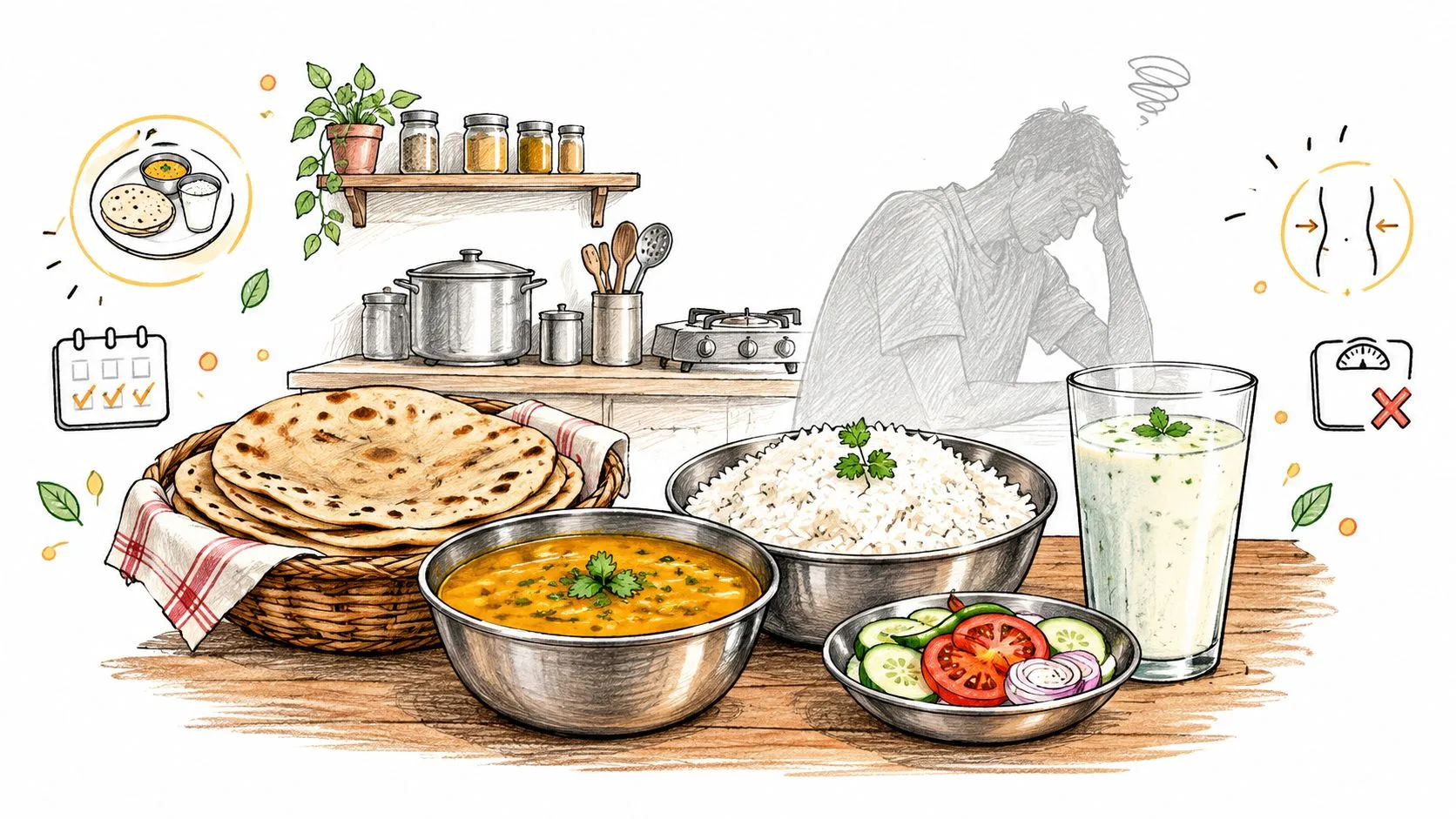
Table of Contents
- Why Most Vegetarian Diets Fail to Add Weight
- Setting Your Daily Calorie and Protein Target
- The Calorie and Protein Density of Indian Staples
- The Core Vegetarian Weight Gain Diet Chart
- Snacks and Drinks That Quietly Add Calories
- Why Protein Quality Matters More Than You Think
- Three Real Indian Variations You Can Follow
Why Most Vegetarian Diets Fail to Add Weight
The usual Indian vegetarian plate is built to satisfy hunger, not to create a controlled calorie surplus. Rice, dal, roti, and a glass of chaas can be a solid meal, but if the portions are modest and the day has no planned snacks, the total intake often stays too low for gain. That's why many adults feel like they're eating enough, while their body keeps behaving as if it isn't.
The hidden problem is meal density
A weight gain diet vegetarian chart has to solve a density problem, not just a quantity problem. Cereals and rotis fill space, but they don't always give enough energy per bite, and a meal that's heavy on bulk can end up stopping you before you've eaten enough. Add a rushed office lunch, a late dinner, and chai with biscuits in between, and the stomach feels busy while the body still misses the surplus.
Practical rule: if a meal doesn't include a real protein source and a calorie-dense addition, it usually behaves like maintenance food, not weight-gain food.
That's why the best charts stop telling you to "eat more" and start showing you what to add, when to add it, and how to spread it across the day. A sensible plan also respects appetite, because many underweight adults don't need giant meals, they need smarter meals. If you want a broader estimate of your daily energy needs, the TDEE guide for Indian adults is useful context before you start increasing portions.
The same logic explains why an "eat anything" approach backfires. More sweets and fried snacks may push weight up, but they don't reliably improve the quality of the gain.
Setting Your Daily Calorie and Protein Target
The first number to decide is your calorie target, because weight gain only happens when intake stays above maintenance. For most adults, a practical starting point is a moderate surplus rather than an extreme jump, so the plan stays sustainable and digestion doesn't fall apart. If your appetite is low, it's better to build up steadily than to overshoot and quit after three days.
Use body weight to set the protein floor
ICMR-NIN's 2024 dietary guidelines set the adult protein RDA at 0.83 g per kilogram of body weight per day (ICMR dietary guidelines). For a 55 kg adult, that means roughly 46 g protein a day. For a 70 kg adult, it's about 58 g a day. Treat that as the floor. If you train regularly, are recovering from illness, or have a medical reason to monitor lean tissue carefully, going somewhat higher is more sensible, but ICMR-NIN notes that more than about 1.6 g/kg a day adds nothing further to muscle gain from strength training, and people with kidney disease should check with their doctor before raising protein.
A simple way to think about calories is this, your day should have enough food to cover normal needs, then a little extra through calorie-dense Indian staples. That extra doesn't have to come from junk. It can come from rice, roti, millets, potatoes, nuts, seeds, dairy, and pulses, all in measured portions that fit your routine.
Useful checkpoint: if you're not gaining after consistent meals, the problem is usually not willpower, it's that the day still isn't dense enough.
If you want a food-first reference point for vegetarian planning, the DietOwl high-protein veg Indian guide is relevant because it shows how high-protein choices can be built from common Indian foods instead of supplements alone. The aim is not to obsess over perfect numbers, it's to stop guessing and give every meal a job.
Quick summary
Daily calorie target: maintenance plus a modest surplus
Daily protein target: at least 0.83 g/kg body weight (the ICMR-NIN RDA), higher if training or recovery needs justify it
The Calorie and Protein Density of Indian Staples
Not all vegetarian foods pull their weight equally. Some foods make a meal larger, some make it denser, and some do both. The smartest weight gain diet vegetarian chart leans on foods that bring useful calories with protein, not just empty bulk.
What adds energy per bite
The Indian Council of Medical Research's 2024 dietary material gives a useful comparison per 100 g raw weight: cereals provide about 343 kcal and 9.3 g protein, millets about 330 kcal and 9.9 g protein, pulses about 323 kcal and 22.8 g protein, and nuts about 516 kcal and 17.5 g protein (ICMR 2024 nutrition material). Pulses also contribute around 12 g fibre per 100 g, while nuts bring about 41.3 g fat, which is exactly why they work well in a calorie-surplus plan when portions are sensible.
Green leafy vegetables sit in a different role. They matter for micronutrients and fibre, but with roughly 45 kcal and 3.8 g protein per 100 g, they can't carry weight gain on their own (ICMR 2024 nutrition material). That's the reason a plate full of salad feels virtuous but doesn't solve underweight status.
| Food group | What it contributes |
|---|---|
| Cereals and millets | Steady energy, useful as the base of meals |
| Pulses | Better protein density, especially in dal, chana, rajma |
| Nuts and seeds | Compact calories, useful in snacks and toppings |
| Dairy | Easy protein and calories without too much volume |
| Leafy vegetables | Micronutrients, not enough energy on their own |
The practical takeaway is simple. Use cereals and millets as the base, pulses and dairy as the protein anchors, and nuts or seeds as the quiet calorie booster. That's also why a chart built around cereal plus pulse plus dairy tends to outperform a chart built around ghee, sweets, and hope.
For a more protein-focused version of this same logic, the DietOwl protein guide for Indian meals is a helpful reference point. If you're trying to judge any food in your kitchen, ask one question, does it give energy, protein, or both?
The Core Vegetarian Weight Gain Diet Chart
A workable weight-gain day sits around 2,200 to 2,500 kcal for many Indian men and usually a few hundred kcal less for women, provided the portions are actually finished and the snack slots are not skipped. The point is not to eat like a bodybuilder, it's to build a repeatable day where every meal carries a purpose. That means the chart needs timing, not just food names.
A full day that real kitchens can follow
Breakfast, 8 to 9 am. Poha or upma made with peanuts, plus curd or milk. Keep the serving generous enough that it feels like a meal, not a snack, and don't leave out the peanuts, because that's where part of the density comes from.
Mid-morning, 11 am. A banana with roasted chana or a small bowl of chana chaat. If appetite is poor, this is the slot where many people do better with something easy to chew and finish quickly.
Lunch, 1 to 2 pm. Roti or rice with dal, sabzi, curd, and a measured fat source like ghee on the thali. The cereal plus pulse plus dairy pattern should show up clearly here, because lunch is usually the most reliable meal of the day.
Evening snack, 4 to 6 pm. Milky chai with a protein-friendly side, such as paneer bhurji in a small roll or roasted peanuts with makhana. The snack should support the day, not just fill the gap with tea and biscuits.
Dinner, 8 to 9 pm. Khichdi with curd, or paneer roti, or rice with rajma and a vegetable. Dinner works best when it's warm, easy to digest, and not so late that it ruins appetite the next morning.
A chart only works if you can repeat it on tired weekdays, not just on ideal Sundays.
Here's a fridge-style summary you can copy:
- Breakfast: poha or upma with peanuts, plus milk or curd
- Mid-morning: banana with chana or chaat
- Lunch: roti or rice, dal, sabzi, curd
- Evening: milky chai with paneer, peanuts, or makhana
- Dinner: khichdi, paneer roti, or rice with rajma
The best version is the one you can finish. If a plate feels too big, reduce volume and increase density, not the other way round.
Snacks and Drinks That Quietly Add Calories
Snacks matter because they solve the gap between meals without demanding another full plate. For underweight adults, that's often the difference between "I ate all day" and "I actually created a surplus." The best snack is usually the one that adds calories without leaving you too full for the next meal.
Build snacks around protein, not just crunch
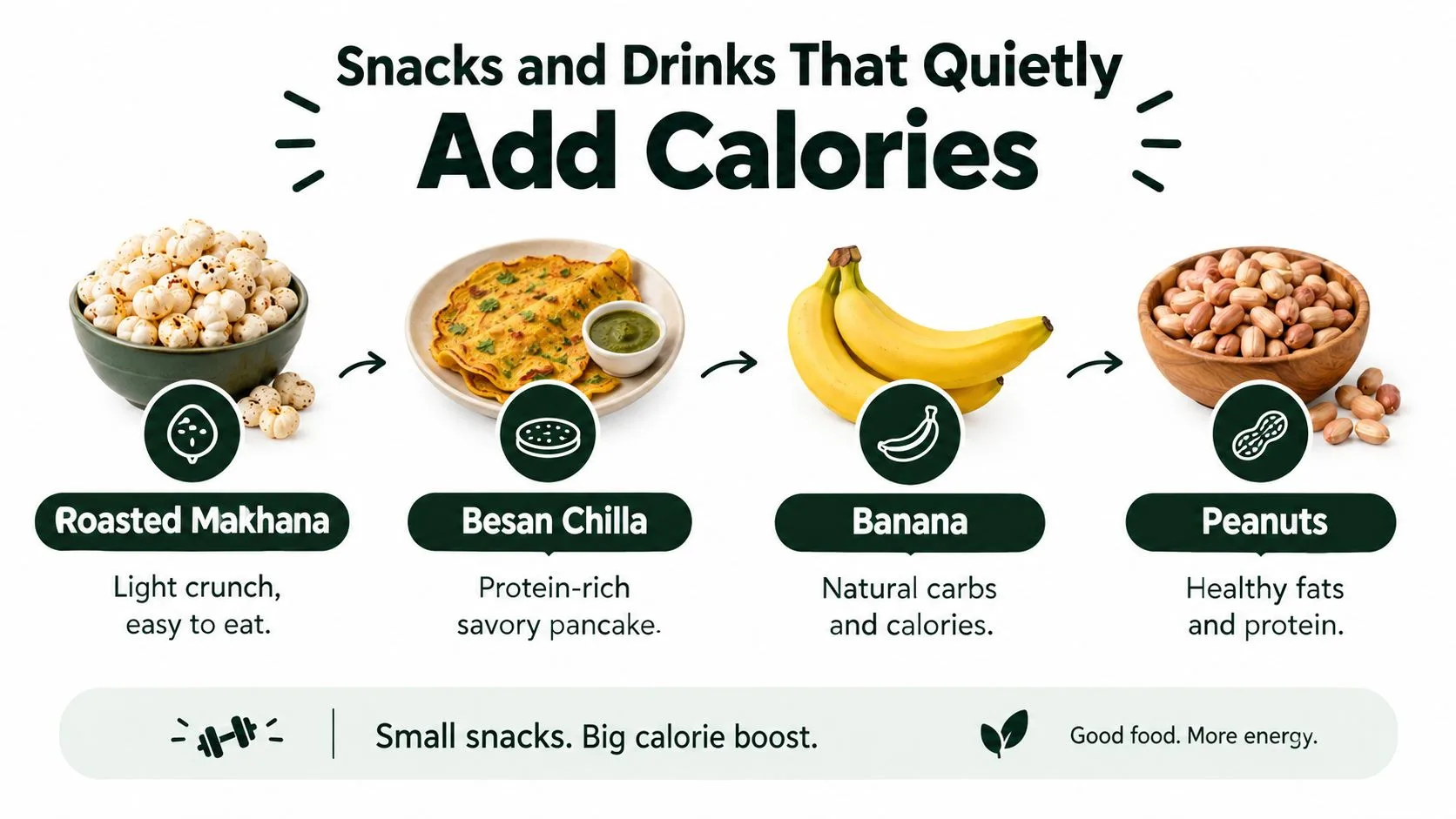
The simplest fix is to pair something easy to eat with a meaningful protein source. Roasted makhana alone is fine, but roasted makhana with peanuts does more. Banana alone gives quick energy, but banana with peanut butter turns into a more useful weight-gain snack. Besan chilla with curd works well because it's savoury, portable, and not dependent on a big lunch appetite.
That pairing logic also helps with digestibility. Indian vegetarian meals often lean heavily on cereals, and one study of about 6,500 adults from four regions of India found vegetarians consumed about 6.4 g less protein and 7.0 g more carbohydrate per day on average than non-vegetarians (PMC analysis of Indian diets). Since Indian diets also get most of their protein from cereals (Indian Journal of Medical Research review), the snack should usually repair the protein side, not just add more starch.
Good options include:
- Roasted makhana and peanuts: light enough to keep eating, dense enough to matter
- Besan chilla with curd: a practical protein snack that feels like food, not a supplement
- Banana with peanut butter: useful when appetite is low and speed matters
- Dry fruit laddoos made at home: good when portions are controlled
- Paneer bhurji rolls: better than biscuits when dinner gets delayed
- Soy chunk chivda: handy for batch prep and travel days
For drinks, milk-based options work better than sugary juices. Chaas can help digestion, milk can add protein and calories at night, and seasonal fruit shakes are useful when made with curd or milk instead of just ice and sugar.
The main rule is simple, every snack should carry some protein, otherwise it only borrows appetite from the next meal.
Why Protein Quality Matters More Than You Think
Most charts stop at total grams. That's not enough for a vegetarian weight-gain plan, because the body doesn't use all protein sources in the same way. If you're living on cereal-heavy meals, the chart can look adequate on paper and still underperform in real life.
Pairing changes the meal
A useful Indian nutrition principle is that grains and pulses complement each other. A small Indian metabolic-availability study found lysine availability of about 87% in a cereal-legume vegetarian meal, compared with about 92% in milk powder, while heat-treated milk powder fell to about 70% (Bandyopadhyay et al., J Nutr 2020). That's not a reason to obsess over laboratory numbers, it's a reason to stop treating dal, curd, paneer, soy, and cereals as interchangeable.
The takeaway is practical. Rice or roti should usually sit next to dal, chana, rajma, soy, paneer, or curd, because that improves the usable protein in the meal. A meal made of only roti and vegetables may feel balanced, but it often leaves the protein side too thin for weight gain. If you want a direct explanation of that problem in dal-based eating, the DietOwl article on whether dal is enough protein is a useful companion read.
The rule is simple enough to remember. Every meal needs one protein source plus one cereal or millet, and every snack should give a second protein hit. That's how the chart becomes more than a list of foods, and starts acting like a real eating pattern.
Three Real Indian Variations You Can Follow
The best chart is the one that matches your kitchen, not someone else's ideal day. A hostel resident, a person eating from a North Indian family thali, and someone who mostly cooks South Indian meals need different structures, even if the overall goal is the same. That's why a weight gain diet vegetarian chart should be modular.
Pick the version that matches your routine
Hostel or bachelor-friendly. Start with poha or bread-based breakfast plus peanuts, use bananas, curd, and roasted chana through the day, and keep one ready option like paneer rolls or soy chivda for the evening. If cooking is limited, milk becomes especially useful because it adds calories without much prep.
North Indian thali-based. Build meals around roti, dal, sabzi, curd, and paneer, then add lassi or milk if appetite is low. This version works well when family cooking is already in place, because the main job is portion control and consistent repetition, not separate meals.
South Indian rice-millet style. Use idli, dosa, rice, sambar, curd rice, and peanut chutney, then make sure the meal is not too low in density. A lot of South Indian eating patterns are nutritious but light, so the weight-gain adjustment usually comes from adding curd, chutney, peanuts, and an extra pulse dish rather than forcing more rice bowls.
The best match depends on three things, your routine, your region, and your cooking time. If you eat outside most days, choose the version that survives travel and late meetings. If you cook at home, choose the one that makes family meals easier rather than harder.
For people who want a structured, coach-led way to keep this consistent, DietOwl offers personalised nutrition planning and WhatsApp-based meal feedback, which can be useful when portions, timing, or food combinations keep slipping. That kind of support matters because the chart only works when the routine survives real life.
Run one version for a week, not forever. Take meal photos, note digestion and hunger, and weigh yourself at the same time on day one and day eight. If energy feels steadier, appetite returns before meals, workouts feel less flat, and your chest or waist measurements start to change before the scale does, the plan is moving in the right direction. If bloating, acidity, or no movement at all shows up, the portions or food combinations need adjustment, not more guesswork. If you have lost weight suddenly or without trying, see a doctor first, because that can point to a medical cause rather than a diet problem.
If you want a chart that fits your region, your routine, and the foods already in your kitchen, visit DietOwl. DietOwl builds personalised vegetarian weight-gain plans, tracks meals on WhatsApp, and adjusts portions when your appetite, schedule, or digestion gets in the way.
Related Topics
Biological Audit
Need a customized Weight Management plan?
Join 100+ Indians on a personalised Indian plan, on WhatsApp.
Deepen your Discovery.
Non-Veg Weight Loss Diet: A Practical Indian Guide
A non-veg weight loss diet that fits Indian kitchens: smart protein choices, portion control, meal timing and a ready weekly sample plan.
Is Corn Flour Good for Weight Loss? An Honest Guide
Is corn flour good for weight loss? Explore the real nutrition, glycaemic impact, portions and Indian meal strategies that decide the answer.

What BMI is Healthy for Indians? (Why the Global Standard is Wrong)
Indian BMI cutoffs are 2 to 5 points lower than WHO global standards because Indian bodies accumulate more body fat at lower BMIs. Here is the correct Indian chart and what each category actually means.