
Is Corn Flour Good for Weight Loss? An Honest Guide
Written By
DietOwl Nutrition Team
Published
2 November 2026
Reading Time
14 min read
If you've ever stood in a kitchen holding a packet of makki atta in one hand and whole-wheat flour in the other, wondering which one is the "safe" choice for fat loss, you're not alone. The confusion makes sense, because corn flour gets praised as traditional and filling in one conversation, then blamed as "too heavy" in the next. The truth sits in the middle, and it's more useful than either extreme.
Is corn flour good for weight loss? Sometimes, yes, but not because it has magic slimming properties. It can fit into an Indian weight-loss diet when the portion is measured, the cooking fat is controlled, and the rest of the plate brings protein and fibre. It can also slow progress when it shows up as a large roti with plenty of ghee and little else.
That's the question worth answering, not whether corn flour is "good" or "bad". By the end, you'll know when it earns a place on your plate, when it doesn't, and how to use it without guessing.
Table of Contents
- Why This Question Keeps Coming Up at the Dinner Table
- What Corn Flour Actually Contains in Numbers
- The Glycaemic Reality Most Recipes Don't Mention
- How Milling, Cooking and Ghee Change the Same Flour
- Putting Corn Flour on a Real Indian Weight-Loss Plate
- Corn Flour vs Corn Starch, Makki Atta and Masa Harina
- Special Cases for PCOS, Diabetes, Thyroid and Post-Pregnancy
- A One-Week Experiment and When to Ask for Help
Why This Question Keeps Coming Up at the Dinner Table
A family meal often starts the debate. Someone weighs makki atta, another reaches for wheat flour, and the question appears: is corn roti the healthier choice because it feels rustic and filling, or is it getting in the way of weight loss?
That confusion is common in Indian homes because corn flour plays two different roles. It belongs to comfort food in seasonal meals, yet it also gets treated like a diet food by people trying to lose a few kilos. Those roles do not match, so the myth grows.
Corn flour behaves like a staple carbohydrate, not a fat-burning ingredient. Indian dietary guidance places cereals and millets inside a balanced pattern and says cereal quantities should be adjusted to body weight and physical activity (ICMR-NIN Dietary Guidelines 2024). That point matters more than any label on the packet.
Practical rule: if a food is mostly carbohydrate, its effect on weight loss depends on portion size, cooking fat and what you eat with it.
A small corn-flour roti with dal, curd, eggs, paneer or vegetables can fit a calorie-controlled day. A large makki roti with plenty of ghee can do the opposite, even if the flour itself is only minimally processed. The flour is one variable, and usually not the biggest one.
What Corn Flour Actually Contains in Numbers
A kitchen label can make corn flour sound lighter than it is, so the numbers matter. The figures here are for makki atta (whole maize flour), the flour used for makki roti. The fine white powder sold in India as "cornflour" is corn starch, a different product covered further down. The ICMR-NIN Indian Food Composition Tables 2017 put dry maize at about 334 kcal, 65 g carbohydrate, 9 g protein, 4 g fat and 12 g fibre per 100 g. Whole-wheat atta is close in calories, at about 320 kcal, with 64 g carbohydrate, 11 g protein, 2 g fat and 11 g fibre per 100 g (IFCT 2017).
Corn flour vs whole-wheat flour per 100 g
| Nutrient | Makki atta (maize flour) | Whole-wheat atta |
|---|---|---|
| Calories | 334 kcal | 320 kcal |
| Carbohydrate | 65 g | 64 g |
| Protein | 9 g | 11 g |
| Fat | 4 g | 2 g |
| Fibre | 12 g | 11 g |
The calorie gap is small. The more noticeable difference is protein: atta brings about 2 g more per 100 g, while fibre is similar in both whole-grain flours. That matters in ordinary meals, since protein and fibre support fullness better than plain starch.
Portion size changes the picture quickly. A 40 g serving of dry maize contributes about 134 kcal and 26 g carbohydrate before oil, ghee, cheese or fillings are added. So a corn roti can fit a weight-loss plan, but it is still a measured carbohydrate, not a free pass.
Simple takeaway: swapping wheat flour for corn flour does not create a calorie deficit by itself. The rest of the meal decides that.
A small roti with dal, curd, eggs, paneer or vegetables behaves very differently from a large roti coated with ghee and served with little protein. In weight loss, the flour is only the base, and the toppings often decide whether the meal stays moderate or becomes heavy.
The Glycaemic Reality Most Recipes Don't Mention
A bowl can look wholesome and still act quickly in the body. That is the part many dinner-table assumptions miss. In research on traditional Indian foods, maize roti had a glycaemic index of 74.8 ± 5.5, which falls in the high category Indian food glycaemic study. The same study reported 84.1 ± 6.7 for sorghum roti and 70.1 ± 3.0 for pearl-millet roti, which shows that a grain being traditional or whole does not automatically mean a slower glucose rise.
What that means in a normal meal
Glycaemic index, or GI, measures how fast a food raises blood sugar compared with a reference food. Glycaemic load adds the serving size. That difference matters because a high-GI food can still have a modest effect in a small serving, while a moderate-GI food can still become a problem if the portion is large.
For Indian adults with prediabetes, type 2 diabetes, PCOS or metabolic-syndrome risk, the confusion often starts here. If a roti pushes glucose up quickly, hunger can return sooner, and that can make weight loss harder to sustain even when the meal looks reasonable on paper. Corn flour is not banned by that fact. It just means the rest of the plate has to do some work.
A practical explanation of GI and glycaemic load in Indian foods is also laid out by DietOwl summary of GI concepts. The National Institute of Nutrition's 2024 guidance uses those same ideas for common Indian cereals and recipes, which reinforces a simple point, the food and the quantity both matter.
Corn roti can still fit a weight-loss plate when it is measured, paired with pulses or protein, and served with non-starchy vegetables. It should not be treated as a guaranteed fat-burning swap for rice or wheat. Response varies from person to person, so the smarter move is to watch the meal, not the label.
How Milling, Cooking and Ghee Change the Same Flour
Corn flour doesn't behave one way in the kitchen. The grind, the cooking method and the fat you add can all shift the meal's effect on fullness and blood sugar. That's why one person's "light" makki roti feels steady, while another person's version leaves them hungry again soon after.
The same flour can act differently
Milling matters because finer powders digest more quickly than coarser ones. Maize varieties can also differ in starch structure, with amylose and amylopectin levels varying by variety. That doesn't make the flour good or bad on its own, but it helps explain why texture changes the meal experience.
Cooking changes things too. The Indian GI study cited above concluded that processing, food structure and preparation can shift a food's GI, and that pairing grains with low-GI legumes may soften the glucose response (Indian food glycaemic study). That's a useful clue for home cooks, because recipe design can shift how the body handles the same basic ingredient.
The fat on top matters just as much. A roti brushed generously with ghee or butter becomes a different meal from the same roti cooked lightly. The flour number stays the same, but the total energy climbs fast. Cooling and reheating may alter starch digestibility, but that isn't a licence for oversized servings.
The best question in the kitchen is not "Is this corn flour healthy?" It's "How was it milled, cooked and served?"
For readers who want a broader fat-quality discussion, this guide on ghee versus seed oils can help frame the conversation without turning every meal into a purity test.
A useful home check looks like this:
- Grind: finer flour usually digests faster.
- Cooking method: boiling, roasting and alkali treatment don't behave the same way.
- Fat load: more ghee or butter means more calories.
- Portion size: the larger the roti, the harder it is to keep the meal in range.
- Pairing: dal, vegetables and protein can make the same roti more balanced.
That workflow is more useful than calling the flour "clean" or "heavy". It puts control back in your kitchen.
Putting Corn Flour on a Real Indian Weight-Loss Plate
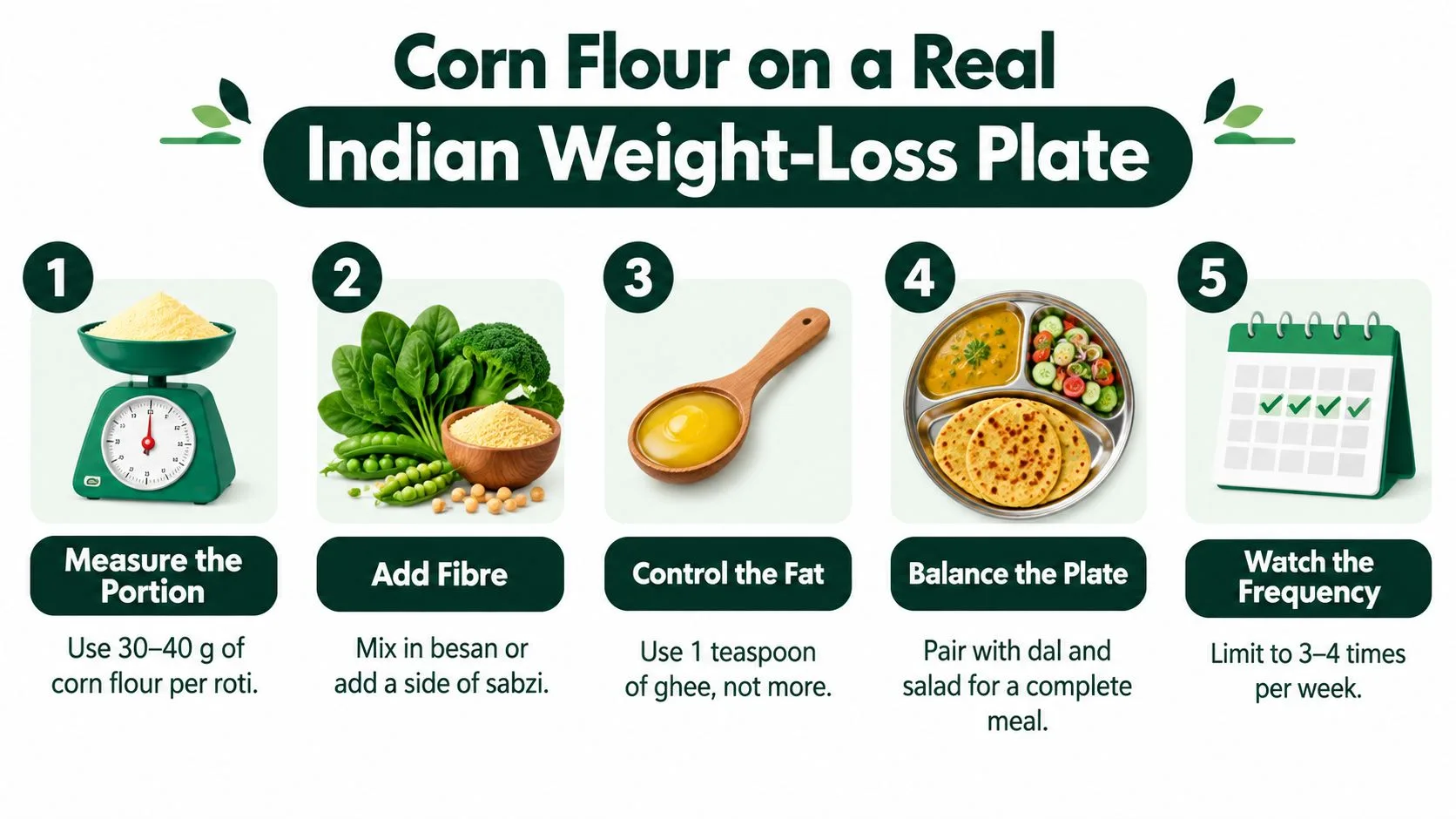
The 40 g serving benchmark from earlier is the anchor. That amount gives a useful reference point for planning, but the meal still depends on what sits beside the roti, not just the flour itself. A measured corn roti can stay on the plate if the rest of lunch or dinner is built with some care.
A plate that actually supports satiety
The easiest way to judge the meal is by the whole thali. Corn flour supplies the carbohydrate base, while curd, dal, paneer bhurji, eggs, chana, fish or mixed beans help the meal hold you over for longer. That is the part many people miss when they treat the roti as the whole story.
Portion size matters because a smaller roti with protein and vegetables can feel more satisfying than a larger plain one. The reason is simple. You get more satiety-supporting nutrients for the same calorie spend, so the meal works harder without needing a bigger flour serving. Corn flour belongs in the role of staple carbohydrate, not centre stage.
Added fat changes the picture quickly. A light smear of ghee is one thing. A heavy coating makes the meal much more energy dense, even if the flour amount stays measured. That is why the same roti can fit one day and push the meal out of range the next.
A practical full-meal frame helps more than flour-only thinking. A plate built around one measured corn roti, a protein dish, and vegetables often lands in a more workable calorie range, while the exact total depends on how much ghee, curd, oil, and filling you add. A simple home-style plate can sit around the mid-hundreds of calories, but a richer version can climb much higher.
A simple plate template:
- One measured corn-flour roti or chilla.
- One protein item, such as dal, eggs, paneer, chana or fish.
- One or two vegetable sides.
- Minimal added fat, just enough for taste and cooking.
- No assumption that the roti alone makes the meal diet-friendly.
That is the difference between using corn flour as part of a planned meal and using it as a reason to underbuild lunch or dinner.
Corn Flour vs Corn Starch, Makki Atta and Masa Harina
These labels sound similar, but they don't behave the same in the kitchen. Makki atta is whole-maize flour, the one used for makki roti, and it is what this guide's numbers describe. It brings the grain's starch, protein and fibre along for the ride. Watch the word cornflour on Indian packets: the fine white powder sold under that name is usually corn starch, not makki atta.
Corn starch is different. It's the starchy extract, with most fibre and protein removed: about 381 kcal and 91 g carbohydrate, but under 1 g each of protein and fibre per 100 g (USDA FoodData Central). It's mainly used as a thickener for soups, sauces and gravies. If a packet says starch, treat it like a binder or thickener, not like roti flour for a weight-loss plan.
Reading the bag correctly
Masa harina is yet another product. It's nixtamalised corn flour used for tortillas, and its processing changes how it behaves in cooking. That means you can't automatically swap it in for makki atta and expect the same result.
The practical question is simple, what job does the product do? If you want a roti, buy a flour intended for flatbread. If you want to thicken a soup or gravy, starch can make sense in a small amount. If you want a tortilla-style dough, masa harina belongs in that lane instead.
Rule of thumb: the more refined the product, the more you should treat it as a cooking ingredient rather than a fullness food.
This matters for weight loss because different corn products bring different levels of fibre, protein and satiety. That doesn't make one morally better than another. It just means the label should match the purpose.
Special Cases for PCOS, Diabetes, Thyroid and Post-Pregnancy
Different bodies handle the same roti differently, so the answer changes by context. For adults with PCOS or prediabetes, the main issue is usually insulin response and hunger timing. A smaller corn-flour portion works better when it is served with dal, curd, eggs, or vegetables, rather than eaten on its own.
For people with type 2 diabetes, the pattern matters even more. The maize-roti glycaemic study cited earlier suggests that this flour can raise blood sugar quickly enough to deserve care, so portion size, modest ghee, and protein plus non-starchy vegetables all matter. A post-meal walk can help some people, but the plate still needs to be built well first.
What to keep in mind by condition
- PCOS or PCOD: keep the portion modest, avoid grazing on corn-based snacks, and pair meals with protein.
- Diabetes or prediabetes: watch the roti size, and use a structured meal pattern such as DietOwl's Indian diabetes diet chart guide alongside clinician advice.
- Thyroid disorders: don't blame the flour alone for a plateau, because total intake and consistency matter more than one ingredient.
- Post-pregnancy: steady meals with protein and vegetables usually help more than restrictive swaps.
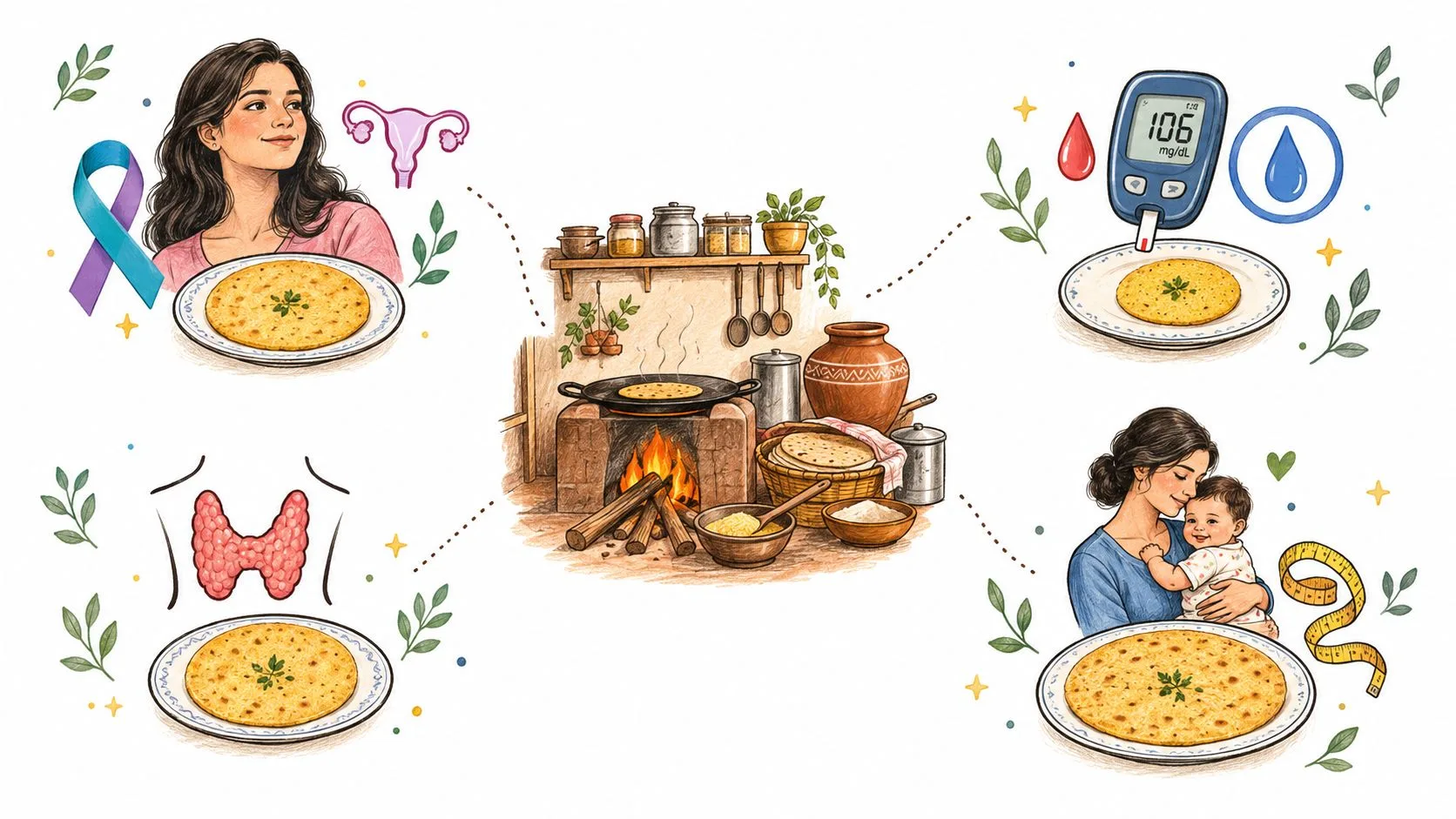
The common thread is adjustment, not avoidance. Portion size, pairings, and frequency decide whether corn flour supports a weight-loss plan or works against it.
A One-Week Experiment and When to Ask for Help
The clearest way to answer the question for your own body is to run a short experiment. Keep the variables small. On two days, eat a measured corn-flour meal. On two other days, eat a measured wheat-flour meal. On the remaining three days, build mixed meals with whichever flour fits your household routine. Write down hunger, energy and cravings after the meal.
That log matters more than internet debates. Some people feel more satisfied with corn flour, some feel no difference, and some notice they get hungry faster when the meal is too plain. Your own response is the one that counts.
The three decisions that matter most
- Portion. Measure the flour instead of pouring by eye.
- Cooking fat. Keep ghee or butter modest.
- Pairing. Put protein and vegetables next to the roti.
If you want support turning that into a plan that works around weddings, travel, family meals and normal Indian food, DietOwl offers WhatsApp-based nutrition coaching, meal logging and portion feedback built around everyday Indian eating patterns. It can be useful when you'd rather have a coach help you adjust the plate than figure it out alone.
If you're trying to lose weight without cutting out the foods your family eats, DietOwl can help you test portion sizes, balance your meals and make corn flour fit your goals instead of fighting them.
Related Topics
Biological Audit
Need a customized Weight Management plan?
Join 100+ Indians on a personalised Indian plan, on WhatsApp.
Deepen your Discovery.

What BMI is Healthy for Indians? (Why the Global Standard is Wrong)
Indian BMI cutoffs are 2 to 5 points lower than WHO global standards because Indian bodies accumulate more body fat at lower BMIs. Here is the correct Indian chart and what each category actually means.
Does Chana Increase Weight? The Truth for Indians
Does chana increase weight? How chickpea calories change with roasting, boiling and portions, and how to fit chana into an Indian weight-loss plan.

Body Fat Percentage for Indians: What's Healthy by Age and Sex
Body fat percentage is a better health indicator than weight or BMI, especially for Indians. Healthy ranges by age and sex, how to measure it, and what to do with your number.