
1800 Calorie Diet Plan Indian: A Practical Guide
Written By
DietOwl Nutrition Team
Published
6 November 2026
Reading Time
18 min read
You're standing in your kitchen at 8 am, looking at the same steel dabba you packed yesterday. Rice, dal, sabzi. Chai is already on the stove. Someone on WhatsApp has sent you a chart that says 1,800 calories, and your first thought is simple. Do I have to give all this up?
You don't. A good 1800 calorie diet plan Indian style isn't a foreign menu of salads and shakes. It's your food, portioned sensibly, with protein fixed first and cereals kept in check. That's the difference between a chart you follow for four days and a pattern you can live with.
Table of Contents
- What an 1800 Calorie Day Actually Looks Like in Indian Households
- Why Most 1800 Calorie Indian Plans Miss the Mark
- A Full Vegetarian Day at 1800 Calories
- Swapping in Non-Veg Without Blowing the Budget
- Smart Snack Swaps That Keep Hunger Away
- Adjusting 1800 Calories for Your Activity Level
- Building Your Plan and Knowing When to Get Help
What an 1800 Calorie Day Actually Looks Like in Indian Households
Think of 1,800 calories as a planning midpoint, not a punishment and not a prescription for everyone. For many Indian adults it sits in the useful zone for gradual weight loss or maintenance, depending on body size and activity. Your job isn't to hit the number perfectly every day. It's to build a daily rhythm that's close enough, most days, without cooking separately for yourself.
Start by splitting the day into four familiar slots. Many people do better with breakfast around 400 calories, lunch around 500 to 550, an evening snack around 150 to 200, and dinner around 550 to 600. That leaves a little room for milk in chai or an extra spoon of sabzi, which is real life. Six tiny meals don't suit most households. Three proper meals plus one planned snack does.
The Three Numbers That Matter More Than the Total
Calories tell you how much. Macros tell you whether you'll stay full. For most adults using this framework, I set a practical range of roughly 60 to 75 grams of protein, 230 to 260 grams of carbohydrate, and 50 to 60 grams of fat, then adjust for body weight and preference. That protein range meets the ICMR-NIN RDA of 0.83 g per kg of body weight for most adults (about 54 g at 65 kg) and sits close to the 15% of calories from protein that the 2024 Dietary Guidelines suggest during a calorie deficit. Protein is the one people miss. If lunch is two rotis, a little sabzi and two spoons of dal, you're not even close, and you'll be hunting for biscuits by 4 pm.
You don't need to weigh everything forever. Use a katori as your anchor for the first two weeks, until your eye learns the portion. This guide to portion control with the Indian katori shows how to use the bowls already in your kitchen instead of buying a scale you'll abandon. One katori of cooked dal, one katori of sabzi, one katori of curd, and one to one and a half katori of rice or two medium rotis is a solid lunch template for most adults on this plan.
What It Looks Like on a Thali
Picture a plate, not a spreadsheet. Half the plate is vegetables and salad. A quarter is your cereal, rice or roti or millet. The remaining quarter is protein, dal, chole, paneer, egg, chicken or fish, with curd on the side if you like it. Fat comes from the tadka, the oil in the sabzi, nuts or seeds, not from an extra pool of ghee poured on top.
Practical rule: Build the plate in this order. Vegetables first, protein second, cereal last. You'll naturally serve less rice when the plate is already full.
Age and life stage change the calculation. A younger active man, a woman after menopause and a new mother shouldn't all eat identical portions just because the total matches. If you're in one of those phases, protein, calcium and hunger needs change alongside calories, so get the plan checked by a nutritionist. For everyone else, the thali above, repeated with variety, is the starting point. Familiar food, normal mealtimes, no shakes required.
Why Most 1800 Calorie Indian Plans Miss the Mark
Most charts fail for one boring reason. They count calories and ignore composition. You can eat 1,800 calories of poha, biscuits, white rice, potato sabzi and sweet chai, hit your target exactly, and still feel hungry, sleepy after lunch and frustrated with your blood sugar. The total looks right. The plate is wrong.
The national picture explains why this happens so easily. The nationally representative ICMR-INDIAB analysis of 18,090 adults, published in Nature Medicine in 2025, reported that carbohydrates supplied about 62% of daily energy while protein contributed only about 12%, and higher carbohydrate energy was linked to a 14% greater likelihood of newly diagnosed type 2 diabetes. That's observational data, not proof that one meal causes diabetes. It does show the default Indian plate leans heavily on cereals and added sugar, with protein as an afterthought.
The Cereal Ceiling Nobody Mentions
India's 2024 Dietary Guidelines from the National Institute of Nutrition and Indian Council of Medical Research recommend that cereals and millets provide no more than 45% of total calories. On an 1,800 calorie plan that's approximately 810 kilocalories from cereals and millets, or roughly 230 g of raw rice or 250 g of atta across the day (IFCT 2017 puts raw milled rice at about 356 kcal and atta at about 320 kcal per 100 g). The same guidance says food quantities vary by age, sex, physiological status and physical activity, and it puts pulses, beans, meat, fish, eggs, vegetables, fruit, nuts and dairy at the centre of a balanced pattern.
Now audit a typical day against that ceiling. Poha for breakfast, two rotis at lunch, rice because dal was made, biscuits with evening chai, then dosa or more roti at dinner. Nobody overate dramatically. Cereals just appeared at every meal while dal stayed watery and vegetables stayed small. You've crossed the ceiling without feeling full.
Context matters too. MoSPI's Nutritional Intake in India report, based on Household Consumption Expenditure Survey data, put average daily per capita intake in 2023-24 at 2,212 kilocalories in rural India and 2,240 in urban India, with the bottom 5% of households by spending near 1,688 and 1,696 kilocalories and the top 5% near 2,941 and 3,092 kilocalories. For a higher intake household, 1,800 is a modest reduction. For a lower intake household, it could be inadequate. Copying a number without asking where you're starting from is sloppy coaching.
The fix isn't removing rice or roti. It's redistribution. Keep one cereal per meal, make dal thicker or add chole, rajma, soya, paneer or egg, double the sabzi, and keep curd or buttermilk in the day. If you want the deficit logic behind this, read about building a calorie deficit with Indian food before you start cutting portions blindly. Better distributed calories beat fewer calories from the same cereal-heavy plate, every time.
A Full Vegetarian Day at 1800 Calories
Here's one complete vegetarian day built the way I'd build it for a client on WhatsApp. Portions are cooked measures unless I say otherwise. Treat the calorie figures beside each meal as planning estimates, not laboratory values. Your oil, your paneer and your roti size will shift them.
Breakfast Around 400 Calories
Option one is mixed veg poha with peanuts and curd. Use a generous plate of poha cooked with onion, peas, carrot and beans, a small handful of roasted peanuts stirred in, and a small katori of curd on the side. The peanuts and curd matter. Poha alone digests quickly and leaves you hungry by 11 am. With fat and protein beside it, the same breakfast carries you to lunch.
Option two suits colder mornings or anyone who finds poha too light. Eat two small methi parathas cooked on a tava with measured oil, filled or served with low fat paneer bhurji. Skip the butter melting on top. You won't miss it once the paneer is properly spiced with jeera, green chilli and coriander. Have your chai, just keep the sugar to a level you'd be willing to write down.
Lunch Around 500 to 550 Calories
Lunch is your anchor meal, so don't make it the smallest. Serve one to two medium rotis depending on your hunger, a full katori of thick dal, a full katori of seasonal sabzi, a plate of salad and a katori of curd. If dal is on the menu daily and you're bored, rotate rajma, chole, lobia and mixed dal through the week. The pulse changes, the structure doesn't.
Rice eaters don't need a different plan. Replace the rotis with about one to one and a half katori of cooked rice and keep everything else identical. What I won't let you do is serve full rice and full roti and then call the two spoons of dal on top a protein serving. Pick your main cereal, enjoy it, and let the pulse and curd do their job.
Evening Snack Around 150 to 200 Calories
This slot decides whether dinner stays controlled. Choose a small bowl of chana chaat with onion, tomato and lemon, or buttermilk with a katori of roasted makhana. Both give you volume and some protein for modest calories. Eat it seated, preferably before you're ravenous. A snack eaten standing at the kitchen counter while cooking dinner rarely registers as a snack at all.
Dinner Around 550 to 600 Calories
Keep dinner lighter in cereal, not lighter in protein. A bowl of moong dal khichdi made with vegetables, served with kadhi or curd and a clear vegetable soup works well on busy nights. On other nights, have one roti with a paneer and capsicum stir fry, a katori of dal or a soya curry, and salad. Soya chunks deserve more respect in vegetarian plans. They're inexpensive, they take on any masala, and they fix the protein gap on days when paneer feels too rich or too costly.
If you're still hungry an hour after dinner, your dinner lacked protein or vegetables. Adding a second roti rarely solves the problem you're actually describing.
Adaptations are straightforward. No curd? Use buttermilk earlier in the day, or add paneer, soya or an extra pulse portion. No dal at night because it feels heavy? Move it to lunch and use paneer, soya or chole at dinner. No onion and garlic? The structure survives perfectly well with jeera, hing, ginger and tomato based tadkas. The template is the point. The specific sabzi in your fridge is not.
Add the day up and you land near 1,800 with three things most vegetarian charts miss. Protein appears at every meal, vegetables appear twice in real portions, and cereal never doubles up. That's why this day keeps people full where a thinner chart at the same calories doesn't.
Swapping in Non-Veg Without Blowing the Budget
Non-veg doesn't need a separate diet chart. It needs swaps. You keep the same thali, the same cereal portion and the same vegetables, and you replace one protein serving with egg, chicken or fish. The main change is that hitting your protein target gets easier. The calorie count barely moves if your cooking method stays sensible.
At breakfast, replace the paneer or curd component on some days with two egg whites and one whole egg, scrambled with onion, tomato and green chilli, eaten with one roti or a slice of toast if that's your household habit. At lunch or dinner, replace one dal serving with grilled chicken, a home style chicken curry with the gravy kept thin, or fish cooked in a light curry or on the tava. Deep frying is what blows the budget, not the chicken itself.
Four Regional Templates That Already Work
- Bengali fish and rice day: Rice in a measured portion, a piece of fish in a light mustard or tomato based jhol, a large serving of mixed vegetables and dal in a smaller katori than usual, since fish is carrying the protein.
- South Indian egg and rasam day: Idli or a measured portion of rice, sambar with vegetables, rasam, and an egg curry or two boiled eggs on the side instead of a second helping of rice.
- North Indian chicken curry day: Two rotis, chicken curry made at home with measured oil, a big sabzi portion and salad. Skip the extra roti you'd normally use to mop up rich gravy.
- Kerala fish moilee day: Fish moilee with coconut milk kept light, red rice or regular rice in a set portion, thoran or another vegetable side in a generous serving.
Notice what these templates share. Nobody's eating chicken breast with steamed broccoli. The regional dish stays. The portion of cereal is decided in advance, the vegetable portion grows, and the gravy is where you control the oil and coconut milk. That's a plan a family can eat together, which matters more than theoretical perfection.
One honest clarification. Non-veg is a tool for hitting protein targets, not a requirement for weight loss. A vegetarian day built properly with thick dal, pulses, soya, paneer, curd and millets works just as well for fat loss at 1,800 calories. I've seen vegetarian clients outperform non-veg clients because their meals were consistent. Choose based on your household, your budget and what you'll eat on a tired Wednesday. Consistency beats category.
Frequency is your call too. Some households eat non-veg twice a week, some daily. Either fits, as long as the vegetarian days aren't treated as low protein rest days. Plan the pulse or soya for those days with the same seriousness, and the week averages out well.
Smart Snack Swaps That Keep Hunger Away
Snacks are where Indian plans leak. Breakfast is disciplined, lunch is sensible, then 4 pm arrives with chai, and out come the biscuits. Nobody decides to ruin their plan. They just eat what's next to the kettle. Fix the snack slot and half the struggle disappears.
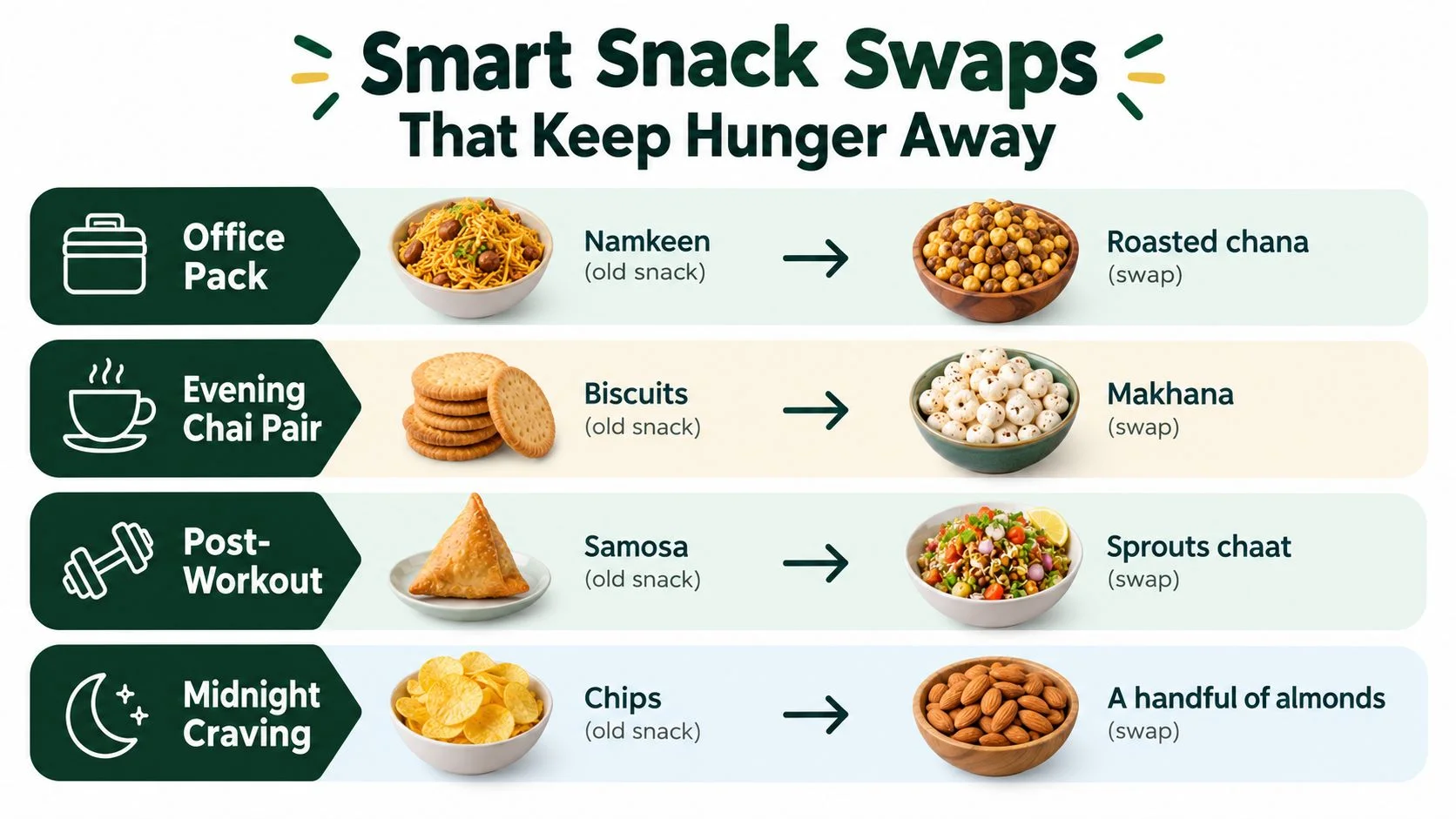
Four Snack Boxes for Four Situations
- Office pack: Roasted chana or a small fruit with peanuts, kept in your desk drawer. It survives heat, needs no fridge and stops the canteen samosa run before it starts.
- Evening chai pair: Roasted makhana with chaat masala, or sprouts chaat made in the morning. You still get the salty, crunchy ritual beside your chai, which is what you wanted.
- Post workout: A boiled egg, paneer bhurji rolled in one small roti, or a curd and oats smoothie with fruit. This snack needs protein, so fruit alone won't cut it.
- Late craving: Buttermilk, a small bowl of curd with cucumber, or a handful of nuts eaten slowly. Keep it small and definitive. Grazing is the enemy, not the food.
The logic behind these swaps goes back to carbohydrate quality. A biscuit and sweet chai snack can match a chana chaat snack in calories while delivering almost no protein or fibre, so you're hungry again within the hour. Same calories, completely different afternoon. When you compare equivalent calorie options, the one with pulse, dairy, egg or nuts wins on fullness every time, and you don't need to count grams to feel the difference.
Now the traps, named plainly. Biscuits with tea, namkeen packets, samosas and bakery bread aren't banned in my plans. Banning them works for about two weeks, then a wedding or an office birthday happens and the whole plan collapses. Instead, schedule them. A samosa on Friday with your chai, counted in the snack slot, with a lighter dinner, is a plan. A samosa eaten daily while pretending snacks don't count is not.
Coach's test: If you couldn't describe yesterday's snacks without thinking hard, that's your problem area. Not lunch, not dinner. The food you don't remember eating.
Stock the swap before you need it. Roast makhana and chana on Sunday, keep sprouts ready twice a week, and move the biscuit tin out of arm's reach of the kettle. Willpower at 4 pm is unreliable. A prepared snack box is not.
Adjusting 1800 Calories for Your Activity Level
The question I hear most is whether 1,800 is too much or too little. The honest answer is that it depends on your day, and the plan should flex by roughly 200 calories either way rather than staying rigid. Your step count on a work from home Tuesday and a day of market rounds and household work are not the same day, so don't feed them identically.
The image below maps activity levels to the same basic bowl of food, which is exactly how you should think about it. The meal doesn't change identity. The portion shifts.
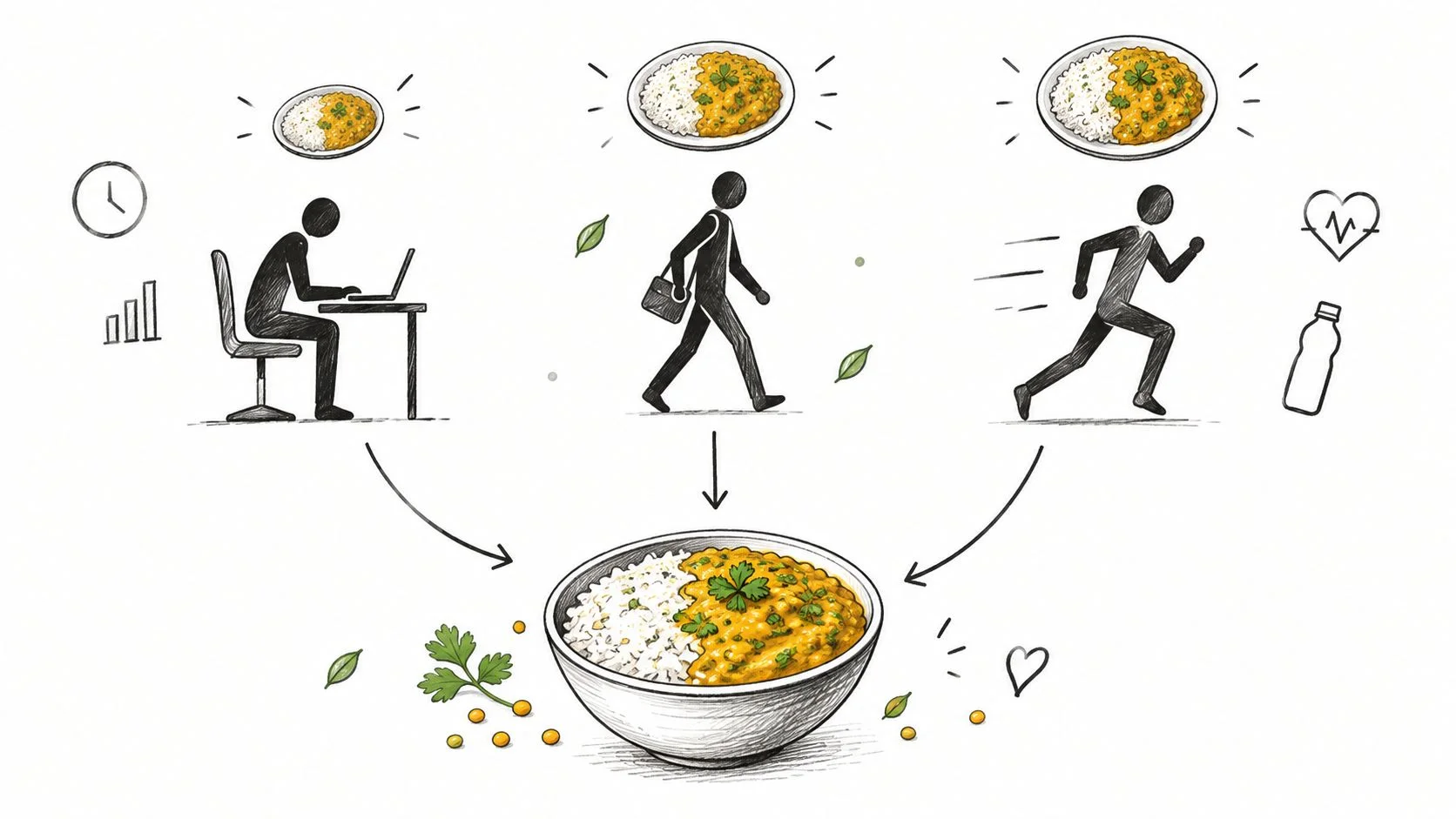
Three Activity Buckets
Sedentary desk job. You're seated most of the day with a short walk at best. Drop towards the lower end by removing one roti at dinner or replacing half your rice with extra vegetables and a curd bowl. Keep protein untouched. Cutting dal to save calories while keeping full rice is exactly backwards.
Moderate walking or household work. You're on your feet through the day, commuting, cooking, managing a home or walking for errands. The standard 1,800 framework usually fits as written. This is the group the template was built for, so change nothing for the first two weeks and watch the trend.
Active labour or regular training. You do physical work or train hard most days. Add roughly 200 calories with a banana and peanuts before your workout, a second roti at lunch, or a glass of milk with your evening snack. Add food, not juice. Liquid calories disappear without filling you, and eating back every exercise calorie through restaurant meals is how active people stall.
If tracking helps you, track properly for a short period instead of guessing forever. Our guide to estimating TDEE for Indian adults explains the maintenance number your 1,800 target should be compared against. Two weeks of honest logging teaches you more than two months of estimating.
Two red flags mean you stop tweaking and get a professional review. Unexplained fatigue, hair fall, dizziness or constant hunger suggests the target is too low or poorly built for you. Weight completely stalled for more than three weeks despite honest logging suggests the target, your activity estimate or an underlying condition needs a proper look. Neither is fixed by cutting another 200 calories on your own.
Building Your Plan and Knowing When to Get Help
Build your own version in this order and you'll avoid most mistakes. Lock protein first by choosing your dal, pulse, paneer, soya, egg or meat for each meal. Choose one cereal or millet per meal and decide the portion before you serve. Pick two vegetable styles for the day, one cooked sabzi and one raw or soup based. Select your snack box the night before. Set a hydration default, water or buttermilk within reach, not juice. Then total the calories and adjust the cereal portion, not the protein, to land near 1,800.
Keep the whole framework on one page in your kitchen. Meal templates, the cereal ceiling from the section above, and your activity adjustment. If your plan needs a spreadsheet to survive a normal Tuesday, it's too complicated and it won't survive a wedding weekend either.
A plan you can follow at your mother's house, in wedding season and during a work trip is worth more than a perfect plan that only works at home.
Be honest about where a generic guide ends. Diabetes, kidney disease, pregnancy, breastfeeding, thyroid or hormonal conditions, post partum recovery and a long plateau all bend an 1,800 calorie template in ways that need individual judgement and medical context. Mid week travel and festival weeks bend it too, and a coach who adjusts your plan weekly around your real schedule saves you the guesswork. Getting help isn't a comment on your effort. It's a shortcut past months of trial and error, and for medical conditions it isn't optional.
If you're tired of rebuilding this framework alone every week, DietOwl gives you a personalised Indian meal plan built around your rice, roti, dal and sabzi, with a qualified health coach reviewing your meals daily on WhatsApp and adjusting your calories as your routine, activity and progress change. Visit DietOwl to start with a plan that fits your kitchen, your medical needs and your actual schedule, not a generic chart.
Related Topics
Biological Audit
Need a customized Weight Management plan?
Join 100+ Indians on a personalised Indian plan, on WhatsApp.
Deepen your Discovery.

Weight Loss Diet Chart for Female: Calories, Meals and PCOS
Weight loss diet chart for female with calorie bands by activity, a sample Indian day plan, PCOS and postpartum changes, and progress tracking.
Vegetarian Indian Diet for Weight Loss: A Practical Guide
A practical vegetarian Indian diet for weight loss: protein-first plates, a one-day meal plan, smart swaps, and tips for PCOS, diabetes and thyroid.
Does Chana Increase Weight? The Truth for Indians
Does chana increase weight? How chickpea calories change with roasting, boiling and portions, and how to fit chana into an Indian weight-loss plan.