
Half Fried Egg Calories: Portion Sizes and Cooking Fat
Written By
DietOwl Nutrition Team
Published
14 November 2026
Reading Time
13 min read
A half fried egg (the Indian half fry: one whole egg cooked on one side, yolk left runny) has about 74 kcal from the egg itself, taking an egg as 50 g as ICMR-NIN does in its 2024 Dietary Guidelines. The fat in the pan adds the rest: half a teaspoon of oil or ghee adds about 20-23 kcal and a full teaspoon about 40-45 kcal, so a half fry made with that much fat comes to roughly 95-120 kcal.
The advice to log a fixed calorie value for every half fried egg leaves out the detail you can measure: what went into the pan. A useful estimate needs both a clear portion definition and a cooking-fat assumption. Without those, a precise-looking entry can describe a different breakfast from the one you ate.
Table of Contents
- Half Fried Egg Calories at a Glance
- Calorie Baseline From Indian Nutrition Data
- How Egg Weight Changes the Calorie Count
- Calories Added by Oil, Ghee and Butter
- Calorie Ranges for Common Home Cooking Methods
- Half Fried Eggs in Indian Breakfasts and Meals
- Logging a Half Fried Egg Accurately
- Comparing Ways to Track Egg Calories
- Your Next Step for Tracking Egg Calories
Half Fried Egg Calories at a Glance
Half fried egg calories aren't a fixed property of the dish's name. A half fry is a whole egg, not half of one, so the estimate above is for one egg. What moves the number is the size of the egg and how much fat goes into the pan.
Yolk texture isn't a reliable shortcut for calorie tracking. The relevant distinction is the amount of edible egg and the fat retained during preparation, as reflected in the Indian nutrition references discussed below. Calling an egg lightly cooked doesn't tell you whether the cook used a dry pan or spooned ghee over it.
Practical rule: Describe the portion and the preparation before choosing the calorie entry.
For everyday tracking, separate what you know from what you're estimating:
- Portion: Record how many eggs you ate and, if you know it, their size.
- Preparation: Note whether the pan was dry, lightly greased or used for basting.
- Uncertainty: If someone else cooked it, mark the fat amount as unknown rather than treating a database default as a measurement.
This distinction matters whether you're organising family breakfasts or recording meals for a personalised nutrition plan. You don't need laboratory precision, but you do need an entry that means the same thing each time you use it. A consistent description is more useful than a calorie figure whose assumptions change between meals.
Calorie Baseline From Indian Nutrition Data
A cooked-food reference and an ingredient-based calculation answer different questions. India's National Institute of Nutrition lists a fried egg at approximately 160 kcal per egg, against 90 kcal for a boiled egg, in the cooked-food table of its older (2011) Dietary Guidelines for Indians. The 70 kcal gap is frying fat, roughly 8 g of it, so that entry suits an egg fried in plenty of oil.
That is a reference for a prepared food. It isn't a measurement of your egg before it entered the pan, and it shouldn't be treated as a fat-free ingredient value.
The distinction is easier to see when the reference types are kept separate.
Choose a calculation route
| Reference type | What it represents | Appropriate use |
|---|---|---|
| Cooked fried-egg entry | A prepared-food estimate | A practical estimate when preparation broadly matches the entry |
| Weight-based egg composition | Nutrients in an edible quantity | A separate egg-and-fat calculation |
| Household recipe record | Your ingredients and serving allocation | A repeatable entry for your usual breakfast |
The important analytical point is not to combine these routes indiscriminately. Adding the entire pan's fat to a prepared fried-egg entry can count some preparation fat again. Conversely, choosing an ingredient-only entry without recording cooking fat can leave part of the preparation unrecorded.
Use the cooked reference when you need a broad estimate. Use the weight-based approach when you can measure the egg and fat separately. Neither approach makes an uncertain household portion exact, but keeping their assumptions distinct prevents an avoidable logging error.
How Egg Weight Changes the Calorie Count
Edible weight is the useful measurement, not the weight of the shell or just the number of eggs cracked. The Indian Food Composition Tables 2017 give a boiled whole hen egg 148 kcal and 13.4 g protein per 100 g edible portion; a 50 g egg, the portion ICMR-NIN's 2024 guidelines use, therefore provides approximately 74 kcal and 6.7 g protein before an allowance for frying fat.
The arithmetic is proportional: edible portion divided by the reference weight, multiplied by the listed nutrient value. These are estimates based on boiled whole egg composition, not direct measurements of a particular fried egg.
Measure the portion you actually eat
A kitchen scale helps distinguish an assumed egg size from a measured one. Exclude the shell, and note whether you're recording an ingredient weight or a cooked serving weight so you don't unknowingly switch methods later.
- For a shared serving: Record the edible egg used in the recipe and how the finished dish was divided.
- For an approximate half: Label the portion as estimated if you divided it by eye.
- Without a scale: Record the egg's size description or package information rather than assuming every egg is identical.
There's another limitation: an unevenly divided egg may not match the composition of a representative whole-egg portion. Treat a serving containing a noticeably different balance of yolk and white as less certain.
The practical conclusion isn't that you must weigh every breakfast forever. Measure your usual portion to establish a reference, then preserve that description in your log.
Calories Added by Oil, Ghee and Butter
Cooking fat should be a separate, explicit assumption when you build an ingredient-based entry. ICMR-NIN counts fats and oils at about 9 kcal per gram (20 g of fats and edible oils = 180 kcal in its 2024 guidelines), so a teaspoon of oil or ghee (about 4.5-5 g) adds approximately 40-45 kcal, and half a teaspoon approximately 20-23 kcal. These are estimated additions, not measurements of what a particular egg absorbed.
Approximate Calories Added by Common Cooking Fats
| Cooking fat amount | Approximate calories added | How to log it |
|---|---|---|
| Measured oil | Use the spoon-based estimate established above | Record the amount allocated to your serving |
| Measured ghee | Use the same approximate allowance | Keep added ghee separate from the egg ingredient |
| Butter | Use the product's nutrition label | Weigh the amount and use the matching product entry |
| Unmeasured drizzle | Uncertain | Record the uncertainty instead of selecting a precise spoon amount |
Butter shouldn't automatically inherit the oil or ghee estimate. Use its own label and a measured amount rather than assuming that every cooking fat has an interchangeable spoon value.
For broader context beyond the calorie calculation, this discussion of ghee versus seed oils addresses a separate food-choice question. Choosing a fat and measuring its contribution are related decisions, but they aren't the same decision.
Record what you added. Don't describe an assumed absorbed amount as though you measured it.
If visible fat remains in the pan, logging all the added fat is a conservative convention, not proof that you consumed it all. Record that convention consistently. When a household recipe serves several people, allocate the recipe's cooking fat across the servings rather than assigning the whole pan's amount to each person.
Calorie Ranges for Common Home Cooking Methods
A useful cooking-method comparison must hold the portion and calculation method constant. Otherwise, a chart can appear to show the effect of cooking technique while comparing different quantities of egg.
For the 50 g egg example established earlier, adding half a teaspoon of fat gives an estimated 94-97 kcal, and a full teaspoon about 114-119 kcal, using the Indian composition values already cited. That ingredient-based result should not be confused with the 160 kcal prepared-food entry in the older ICMR-NIN table.
The preparation categories below help identify which assumptions belong in your entry.
Match the method without switching baselines
- Dry non-stick pan: Use an ingredient-based estimate without an added-fat entry if no fat was used. The boiled-egg composition remains a proxy, not a direct analysis of dry-pan cooking.
- Measured oil: Keep the same egg portion and add the measured allowance assigned to it.
- Ghee finish or butter basting: Record the finishing fat too. Fat added after the egg starts cooking still belongs in the recipe.
The 160 kcal table entry is a prepared-food estimate with its own, larger fat allowance built in. Don't add your teaspoon on top of it.
That difference explains why apparently conflicting calorie figures can both arise from reasonable calculations. The question isn't only which number is correct. Ask which portion, reference entry and fat assumption produced it. Once those match your preparation, the estimate becomes interpretable.
Half Fried Eggs in Indian Breakfasts and Meals
Consider a breakfast of roti and a half fried egg. Record the roti and the egg separately, then identify whether ghee was added to the roti, used in the egg pan or shared between them. A combined breakfast entry makes those details harder to inspect later.
With toast, distinguish bread, any spread and the egg preparation. If you use the same butter for the toast and the pan, account for its total allocation without entering it twice. These are proposed logging examples, not measured meal analyses.
Treat each plate as a recipe
| Meal example | Keep distinct in the record | Question to resolve |
|---|---|---|
| Roti with egg | Roti, egg and added fat | Was either component finished with ghee? |
| Toast with egg | Bread, spread and pan fat | Has the butter already been counted? |
| Poha or upma with egg | Prepared staple and egg preparation | Does the staple entry match the household recipe? |
For poha or upma, a useful record includes the serving description and preparation details rather than only the dish name. The egg entry can't compensate for an uncertain staple portion.
You also can't conclude that the egg supplies a modest or dominant share of breakfast energy without evaluating the rest of the plate. That share depends on the actual quantities and recipe, not the meal's label.
When considering Indian breakfast choices for weight loss, keep meal selection separate from accounting. First decide what fits your routine and nutrition plan, then record the ingredients served. There's no need to reject an egg breakfast because its cooking fat needs a separate entry.
Logging a Half Fried Egg Accurately
A repeatable log should preserve the details another person would need to reconstruct your estimate. Weight, fat allocation and preparation method matter more than an elaborate dish name.
Use this checklist alongside your usual meal record.
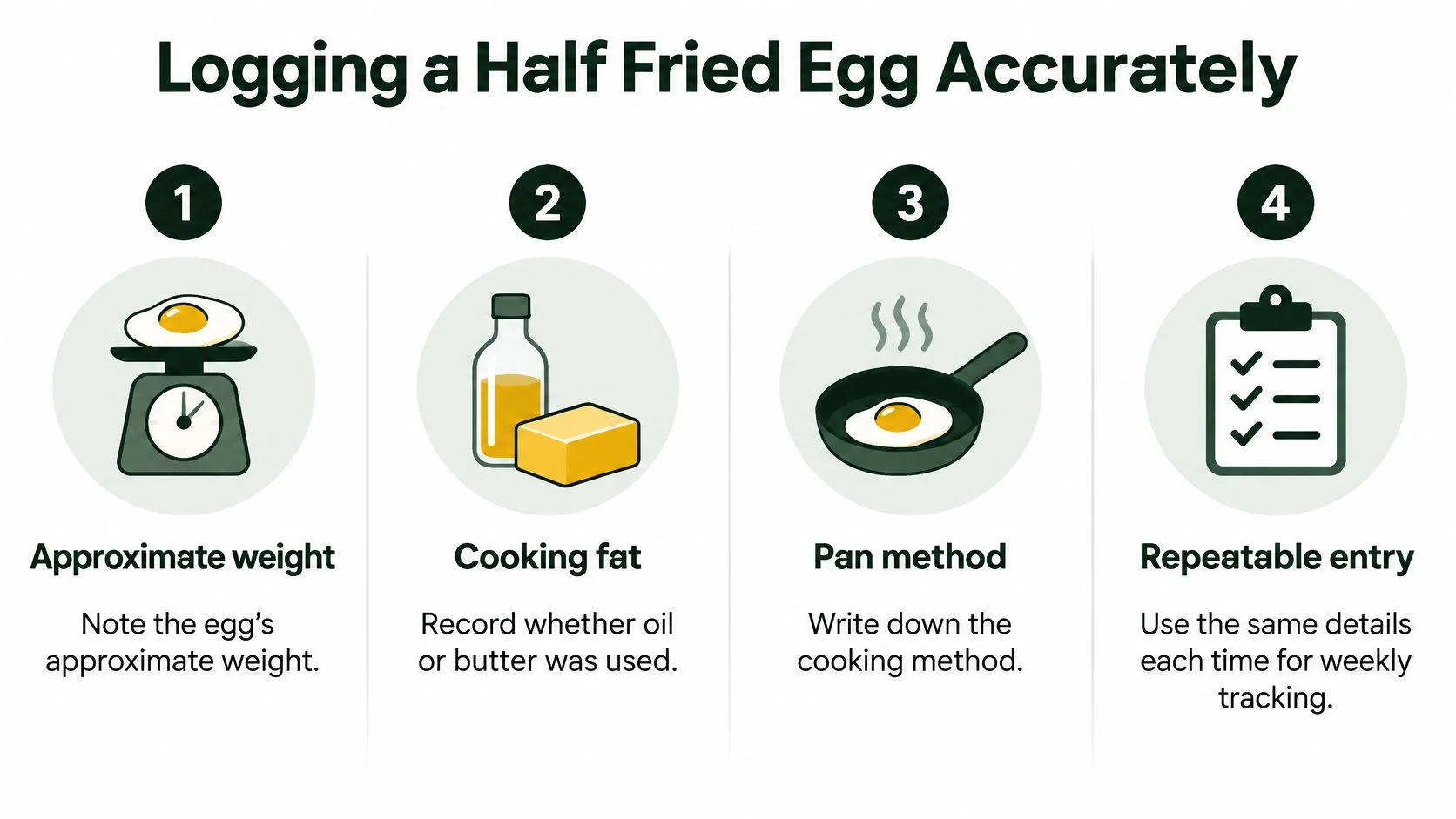
- Describe the egg portion: Note edible weight when available, whether it was divided by eye, and how many eggs you ate.
- Record cooking fat: Include the type, measured amount and your share of a shared recipe.
- Name the pan method: Specify dry-pan cooking, light greasing or basting, and note any visible fat discarded.
- Save the assumptions: Keep the reference entry and preparation notes together so you can reuse them without reconstructing the calculation.
A meal photo can supplement that record, but don't ask the image to establish a fat quantity you haven't supplied. Add written cooking details alongside the image.
For readers organising a calorie deficit around Indian food, this approach makes the meal entry easier to review. Save a description such as one egg, measured oil, shared pan, rather than a bare half fried egg label. Update it when the recipe changes instead of automatically repeating yesterday's assumptions.
Comparing Ways to Track Egg Calories
Choose a tracking method by asking what information you can reliably provide, not which method displays the most precise-looking total. A detailed interface can't resolve an unknown recipe on its own.
The options can be compared by their inputs and limitations.
| Tracking approach | Accuracy consideration | Effort | Repeatability |
|---|---|---|---|
| Generic fried-egg entry | Depends on how closely its portion and recipe match yours | Minimal preparation detail | Easy to repeat, including any mismatch |
| Weighed egg and measured fat | Makes the main inputs explicit | Requires measuring and allocating ingredients | Repeatable when the recipe stays consistent |
| Coach-reviewed meal record | Allows questions about missing details | Requires photos, notes and discussion | Useful when agreed assumptions are saved |
A generic entry is an estimate, not a failed measurement. It can serve as a practical placeholder when eating away from home, provided you mark the preparation as uncertain.
A weighed entry suits a home recipe you can observe directly. Coach review is a different layer: the reviewer can ask whether the egg was whole, whether the pan was shared and whether a finishing drizzle was omitted. Review doesn't turn an unseen fat amount into a measured quantity.
Choose detail you can sustain: A clearly labelled estimate is more transparent than an exact-looking entry built on missing information.
During travel or festival meals, preserve that distinction. Ask about preparation when practical, record what remains unknown and return to your measured household recipe when you're cooking again.
Your Next Step for Tracking Egg Calories
At your next home breakfast, weigh the edible egg portion and measure the cooking fat before it reaches the pan. Record the portion you ate, how the fat was allocated and whether you used a prepared-food entry or an ingredient-based calculation.
Check whether the entry matches your routine
- Look for a portion mismatch: Does the saved entry describe the amount you serve?
- Check the recipe: Has an extra drizzle, toast spread or shared-pan ingredient been left out?
- Preserve uncertainty: If you didn't measure something, label it as an estimate.
Repeat the process across your usual breakfasts until you have a description you can reuse confidently. Judge the habit by whether you can explain the entry, not whether the calorie total looks impressively precise.
The most useful outcome is a reliable household recipe record. Once that exists, you can adjust it when your egg portion or cooking method changes without starting from a vague dish label again.
DietOwl offers personalised nutrition coaching on WhatsApp, with meal-photo review and feedback to help you record portions and cooking fat in the context of your usual Indian meals. Visit DietOwl to explore coaching support and bring your egg portion, pan method and measured fat details to your meal review.
Related Topics
Biological Audit
Need a customized Indian Nutrition plan?
Join 100+ Indians on a personalised Indian plan, on WhatsApp.
Deepen your Discovery.
How Much Protein Is in 1 Egg? Boiled, Whole and Per 100 g
One large egg gives about 6.28 g of protein, whether raw, fried or poached. Here are boiled, white, yolk and per 100 g values, plus what 2 to 5 eggs add up to.
Indian Corn Recipes: 9 Regional Dishes to Cook at Home
Explore 9 corn recipes Indian kitchens love, from makki di roti to corn chaat, with prep steps, variations and nutrition notes for balanced meals.

Is Rice Really Bad for Weight Loss? An Indian Dietitian's Truth
Rice is not bad for weight loss. Eating rice without thought, portioning, and pairing is. Here is what the science actually says, and how to eat rice while losing weight.